Table of Contents
- Why the sharpening angle makes all the difference on a forged knife
- Understanding the total sharpening angle and the angle per side
- Difference between a 15 and 20-degree knife angle: which one to choose
- The influence of steel hardness on the sharpening angle
- How to sharpen a knife on a stone: the step-by-step method
- The best professional kitchen knife sharpener for a consistent angle
- Forged knife sharpening frequency: when to resharpen the blade
- Micro-bevel, polishing, and cutting test: confirming your angle
- Frequently Asked Questions
Last updated: September 21, 2026
Why the sharpening angle makes all the difference on a forged knife
The sharpening angle is the measurement in degrees formed between the two faces of the blade's edge. Knowing the right sharpening angle for a forged steel knife determines everything: ease of cutting, edge retention, and blade durability.
Choosing the right angle means finding the balance between an edge that bites into food and an edge that survives contact with the cutting board. Too sharp, and the edge chips. Too blunt, and it crushes instead of slicing.
Forged steel is dense and durable. It is unforgiving of geometry errors, but it greatly rewards well-thought-out sharpening.
The question is therefore not "what is the best angle?" but "what angle is suitable for this steel, this blade, and this use?". This is what we will detail.
Understanding the total sharpening angle and the angle per side
The total sharpening angle is the sum of the two angles formed on each side of the edge. The angle per side is half of this value, measured on a single face.
A knife advertised at "20 degrees" can therefore mean two very different things. If 20° refers to the total angle, each face is angled at 10°. If 20° refers to the angle per side, the total reaches 40°, resulting in a much sturdier but less biting blade.
This confusion is the number one source of error among amateurs. Many sharpen at 20° per side believing they are following the classic 20° recommendation, and end up with an edge that slides over tomatoes.
| Term | Definition | Common example |
|---|---|---|
| Angle per side | Inclination of a single face | 15° or 20° |
| Total angle | Sum of both faces | 30° or 40° |
| Sharp angle | Less than 15° per side | Fine, delicate cut |
| Obtuse angle | More than 20° per side | Robust, less precise cut |
The practical rule: always remember the angle per side when sharpening by hand. It is the value that your fingers and wrist actually control.
Difference between a 15 and 20-degree knife angle: which one to choose
The difference between a 15 and 20-degree angle comes down to a simple compromise: 15° cuts more finely, 20° lasts longer.
A 15° angle per side produces a very sharp edge. It glides through vegetables, slices herbs without crushing them, and is suitable for precision work. In return, this edge wears quickly on a board and does not handle bones or frozen foods well.
A 20° angle per side produces a stronger edge. It resists repeated cuts, poultry, and root vegetables better. It requires a little more force, but it retains its sharpness much longer.
Here is how to slice depending on your situation:
- Versatile chef's knife: 15 to 17° per side for a good balance
- Paring or utility knife: 15° per side for finesse
- Boning or bread knife: 20° per side for strength
- Pocket knife: 20 to 25° per side, as it works in harsh conditions
- Intensive daily use: opt for 20°, you will sharpen less often
The influence of steel hardness on the sharpening angle
Hardness is only half the equation. What determines the angle a forged steel can actually hold is the hardness/resilience combination. A very hard but brittle steel will chip on a fine angle, even if its HRC value suggests otherwise.
Hardness is measured on the Rockwell C scale (HRC). Resilience, on the other hand, is not read on a label: it depends on the composition, heat treatment, and forging method. This is where general guides stop, and this is where everything is decided on a forged knife.
Distinguishing families of forged steels
Not all "forged steels" behave the same. Three families appear in the kitchen:
- Hand-forged carbon steel (types XC75, 1095, 52100): high hardness, fine grain, edge that bites quickly. It accepts 15 to 17° per side, but oxidizes and requires regular maintenance. Its resilience is good as long as you do not go below 13°.
- Industrially forged stainless steel (types X50CrMoV15, 4116, VG-10): more corrosion-resistant, often softer (54-57 HRC). It holds an angle of 18 to 20° per side better. Going down to 15° gives an edge that shines but dulls in a few cuts.
- Forged Damascus and multi-layer steel: the hard core (often 60-62 HRC) holds the edge, but the softer outer layers scratch and deform if the angle is too fine. Stay at 15 to 17° per side, never less, except on Damascus whose core is explicitly designed for a sharp angle.
The mechanism: why resilience limits the angle
A cutting edge is a corner. The sharper the angle, the more the pressure exerted on the edge in contact with the board is concentrated. If the steel lacks resilience, this concentration creates micro-cracks that become chips.
A well-quenched forged carbon steel combines hardness and resilience: it absorbs the stress concentration. A softer industrial stainless steel deforms plastically instead of breaking, which dulls the edge without chipping it, a different behavior, but just as detrimental to edge retention.
In practice, remember these guidelines:
- Soft steel (less than 55 HRC): 20° per side minimum, otherwise the edge will fold
- Medium steel (55 to 58 HRC): 17 to 20° per side, the most versatile zone
- Hard steel (58 to 61 HRC): 15 to 17° per side, provided the quench is successful
- Very hard steel (beyond 61 HRC): 12 to 15° per side, but fragile on a hard board
The special case of hand-forged steels
On a hand-forged knife, the quench is often selective: the edge is harder than the blade. This allows a finer angle on the edge while keeping a flexible blade. But this selective quench is difficult to reproduce and varies from one blacksmith to another.
If you do not know the exact hardness of your blade, go with 17° per side. It is the compromise that forgives the most uncertainty on a forged steel of unknown origin.
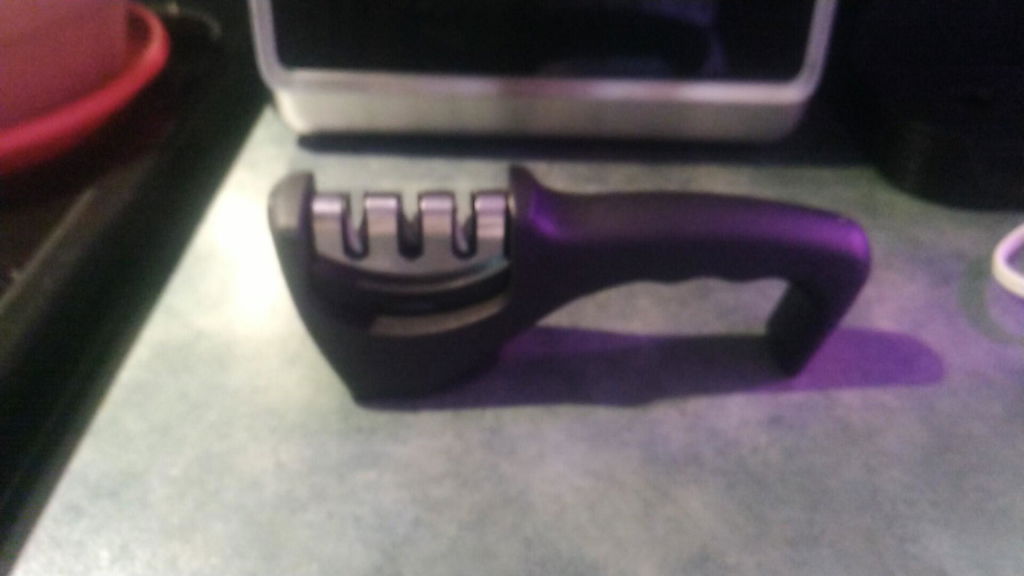
A pre-set angle sharpener removes this uncertainty. The 4-stage model guides each pass and keeps the same angle from start to finish, which avoids creating an irregular bevel on an expensive steel.
How to sharpen a knife on a stone: the step-by-step method
The method on a whetstone remains the reference for forged steel. It requires consistency, not force.

Total duration: 15 to 25 minutes Difficulty: intermediate
What you need:
- A medium-grit whetstone (1000) and a finishing stone (3000 to 6000)
- A cloth and a bowl of water
- An angle guide if you are a beginner
- Prepare the stone. Soak it until no more bubbles rise. Place it on a damp towel to stabilize it.
- Find your angle. Lay the blade flat, then lift the spine until you feel the chosen angle. An angle guide helps keep it constant.
- Start the rough sharpening. Pass the blade over the 1000 stone pulling in a regular motion. Count 10 passes per side.
- Check the burr. Run your finger over the opposite edge: a small catch indicates that the edge is formed.
- Polish. Pass over the fine stone to remove the burr and refine the edge.
- Refine with leather. A few passes on a stropping leather aligns the edge and extends edge retention.
Expected result: the knife slices a sheet of paper without tearing it.
Knife sharpener | Professional 10 →
The best professional kitchen knife sharpener for a consistent angle
The best sharpener is not the most expensive or the most complete: it is the one that maintains the angle you have chosen, without drifting, over the entire length of the blade. On forged steel, this consistency matters more than the speed of execution.
Why the hand drifts (and why it matters)
Holding a constant angle by hand is difficult for a mechanical reason: the wrist has no fixed reference. After about ten passes, the typical drift is between 2 and 5°. On an edge aimed at 15°, this means a bevel that oscillates between 12 and 18° along the blade.
Result: the edge cuts in places and slides elsewhere. On hard forged steel, this irregularity creates weak points where the edge chips first.
The three families of systems and what they require
- Pre-set slot systems: the angle is fixed by the geometry of the slots. Simple, fast, but the angle is imposed (often 20° per side). Suitable for soft stainless steels and routine maintenance, less so for hard steels that require a finer angle.
- Cylindrical roller systems: the blade is held by rollers that fix the inclination. The angle is chosen by the user (generally 15° or 20°). Good compromise for medium forged steel.
- Rod-guided stone systems: the rod rigidly fixes the angle, often adjustable to the degree. This is the most precise solution for hard forged steel requiring 15° or less. Slower, more technical.
The deciding factor: compatibility with hardness
A system with slots preset at 20° on forged steel at 60 HRC is a bad match: it imposes an angle that is too obtuse for steel that could hold 15°. Conversely, a rod system set at 12° on stainless steel at 54 HRC will produce an edge that folds at the first contact with the cutting board.
The rule for determining the sharpening angle for a forged steel knife: first choose the angle according to the steel (see previous section), then the system that maintains this angle. Not the other way around.
What Hell-kitchen-equipment offers
We offer professional sharpeners that maintain a consistent angle:
- 4-stage model: combines sharpening, honing, polishing, and stropping. Suitable for medium to hard forged steels, with an angle maintained along the entire length.
- 2-in-1 model: combines a diamond surface and a polishing surface, with a non-slip base for stability. Adapted for the regular maintenance of a forged knife between full sharpenings.
- 10-second model: compact format that folds and stores away. For quickly restoring the edge without taking out a whole set of equipment.
The consistency test after use
To check that a sharpener maintains the angle properly, a simple test: run your finger along the entire length of the edge, from the heel to the tip. The resistance should be uniform. If you feel areas that catch more than others, the angle has drifted or the bevel is uneven.
A second test: cut a sheet of paper starting from the heel, then from the tip. If one of the two ends tears, the bevel is not homogeneous.
Forged knife sharpening frequency: when to restore the blade
A forged knife used every day requires light sharpening every week and a full honing every two to three months. Occasional use doubles these timeframes.
The frequency depends on three factors: the hardness of the steel, the type of cutting board, and the volume of cutting. A glass or ceramic cutting board dulls an edge much faster than a wooden board.
Look for the signs that indicate it is time:
- The blade crushes the tomato instead of slicing it
- The knife slips on the chicken skin
- You have to press down to cut an onion
- The edge catches the paper without cutting it cleanly
Razor stropping, done once a week, realigns the edge and postpones the full sharpening. It is the most cost-effective action to prolong the cutting edge.
A compact sharpener makes this maintenance simple. The Professional Knife Sharpener | Professional 10-second folds and stores in a drawer, allowing you to restore the edge in a few steps as soon as it weakens, without taking out a whole set of equipment.
Micro-bevel, polishing, and cut test: validate your angle
The micro-bevel is a small additional facet created at the end of the edge, with a slightly more obtuse angle. It strengthens the tip of the cutting edge and improves the edge retention.
Many sharpeners create this micro-bevel without saying so. This is a good thing: it protects a very sharp main angle against chipping. Polishing, on the other hand, removes the residual burr and aligns the edge for a clean cut.
To validate your angle, two tests are enough:
- Tomato test: a well-sharpened blade bites the skin without pressure and slices the flesh without crushing it
- Paper test: the knife cuts a sheet held in the air in one continuous motion, without tearing
If the blade crushes or tears, the angle is too obtuse or the burr has not been removed. If it chips after a few cuts, the angle is too sharp for the hardness of the steel.
The geometry of the blade also matters. A blade thick on the back, common on forged knives, supports a thinner angle because it remains rigid. A thin blade on the back requires a more obtuse angle so as not to flex. Look at the thickness on the back before choosing, it is the detail that most guides forget.
Choosing the right angle for a forged steel knife requires taking into account the steel, the geometry of the blade, and your actual use. This is what separates an edge that holds from an edge that chips.
Hell-kitchen-equipment offers professional sharpeners. The Professional Knife Sharpener | Professional combines the steps for a clean result, the Professional Knife Sharpener | 10-second combines a diamond surface and polishing, and the Professional Knife Sharpener (compact) stores anywhere. Each one simplifies maintenance and prolongs the life of your blades.

Visit us to equip your kitchen with tools that really work.
Frequently Asked Questions
What is the ideal sharpening angle for a forged steel kitchen knife?
For a forged steel kitchen knife, the sharpening angle is generally between 15° and 20° per side. A 15° angle is suitable for hard steels (58-60 HRC) and fine cuts of vegetables or fish. A 20° angle is more suitable for softer steels or knives subjected to intensive use, because the edge resists impacts better. The essential thing is to remain consistent between the two sides of the blade for a symmetrical edge.
Should you sharpen a knife at 15 or 20 degrees?
The choice depends on the use and the steel. A 15° angle offers a finer and more precise cut, ideal for vegetables and fillets. A 20° angle gives a more resistant edge, preferable for versatile chef knives or softer steels. For a versatile forged knife, a compromise at 17-18° per side works well. Test with a tomato: if it crushes instead of slicing, refine the angle or redo the sharpening.
How to maintain a constant angle during manual sharpening?
Use an angle guide clipped to the back of the blade to set the inclination. Failing that, stack two 1 euro coins under the back of the blade to approximate 15-20°. Work with slow and regular passes, counting the movements on both sides. A preset angle sharpener, like the Professional 10-second Knife Sharpener at €22.99, eliminates this risk by guiding the blade in calibrated slots.
Does forged steel require a different angle than classic stainless steel?
Forged steel is denser and often harder (56-60 HRC) than standard stamped stainless steel. A sharper angle, around 15-17° per side, makes better use of this hardness and gives superior edge retention. Classic stainless steel, softer, does not tolerate a too closed angle well: it dulls quickly. For a forged knife, aim for 15-17°; for stamped stainless steel, stay at 20°. The Rockwell hardness of your blade is the best indicator.