Table of Contents
- Why Investing in High-Performance Knives Changes Your Daily Life
- Cutting Precision and Performance: What Makes a Difference with a Forged Blade
- Kitchen Safety: Reducing the Risk of Injury
- Durability and Savings: Total Cost of Ownership
- How to Maintain Your Kitchen Knives So They Last
- Forged vs. Stamped Knives: What Really Makes a Difference
- How to Sharpen a Professional Knife Without Damaging It
- Weight, Balance, and Ergonomics: The Criteria That Matter
- Beginner or Expert: Which High-Performance Knives to Choose?
- Frequently Asked Questions
Last updated: September 19, 2026
Why Investing in High-Performance Knives Changes Your Daily Life
Investing in high-performance knives radically transforms food preparation, as a quality blade reduces effort, improves cutting precision, and lasts for years rather than months. A well-designed knife makes cutting feel fluid rather than like a struggle. According to the National Consumer Institute, the right kitchen equipment that is properly maintained limits premature wear and repeated expenses.
The real question is not whether you can afford it, but how much your dull equipment is already costing you.
The Hidden Cost of Low-End Knives
A cheap knife costs little to buy, but a lot to use. The blade dulls quickly, the edge deforms, and the handle becomes loose. You have to apply more force, crush the food, and buy another one. This cycle, repeated every year or two, eventually costs more than a good knife purchased once.
Cutting Precision and Performance: What Makes a Difference with a Forged Blade
The difference between a forged blade and a stamped blade lies in the steel's structure, which determines how well it holds its edge. A forged blade is worked while hot, densifying the steel and prolonging its sharpness. A stamped blade is cut cold from a plate that is thinner and faster to produce.

In practice, a forged blade cuts through food instead of crushing it. Tomatoes remain firm, herbs are cleanly sliced, and fish is cut into neat slices. This precision changes the final result of a dish, but also the enjoyment you get from preparing it.
The Japanese Knife | Forged Steel illustrates this principle well: a hammered blade, balance carefully designed between the bolster and the handle, and stainless steel that resists corrosion.
Kitchen Safety: Reducing the Risk of Injury
Kitchen safety depends less on caution than on the quality of the blade. A knife that cuts without forcing requires less pressure, slips less, and is easier to control. In contrast, a dull tool makes you apply more pressure, causing your hand to shake and the blade to slip.
Three habits significantly reduce the risk:
- Maintain a consistent edge rather than waiting until the blade no longer cuts
- Use the right blade size for each task
- Place a stable, non-slip cutting board before you start
Durability and Savings: Total Cost of Ownership
Total cost of ownership is the purchase price plus maintenance and replacement costs over several years. A cheap disposable knife is often replaced; a well-maintained high-performance knife stays in service much longer.
| Knife Type | Estimated Price | Maintenance | Replacement | Cost Over 5 Years |
|---|---|---|---|---|
| Low-End | Low | Rare | Frequent | High |
| Well-Maintained High-Performance | Moderate | Regular | Rare | Low |
The reasoning is simple: spending once on a good tool often costs less than constantly buying new ones. This is what is known as a worthwhile investment.
How to Maintain Your Kitchen Knives So They Last
Regular maintenance is what separates a knife that lasts ten years from one that lasts one year. Washing by hand, drying immediately, and storing on a stand or in a case: these simple actions protect the blade and handle.
Absolutely avoid:
- Dishwashers, which damage the steel and wood
- Prolonged soaking, which promotes corrosion
- Storing loosely in a drawer, which dulls the edges
Specific Care for Different Types of Steel
Not all steels are treated the same way. The general rule: the harder the steel, the more carefully it must be handled. But this rule varies depending on the steel family.
Classic Stainless Steel (X50CrMoV15 type, very common in European kitchen knives)
- Typical hardness: 54-56 HRC
- Can tolerate moisture for a few minutes, but not soaking
- Easy to sharpen with a honing rod or fine whetstone every 15 to 30 days, depending on use
- Dry with a towel immediately after washing
High-End Japanese Steel (VG10, SG2/R2, high-carbon steels)
- Typical hardness: 60-63 HRC
- Immediate drying is mandatory: a damp VG10 blade can develop spots in a few hours
- More delicate sharpening: a steeper angle (often 10-15° per side), light pressure, and a 1000-grit whetstone followed by 3000-6000
- A roller or progressive-stage sharpener prevents you from varying the angle by hand
Non-Stainless Carbon Steel (Shirogami, Aogami types)
- Exceptional sharpness, but rusts at the slightest neglect
- A natural patina is expected: it protects the blade if it is uniform
- Light oiling is recommended if the knife is not used for several weeks
The Real Cost of Maintenance Over Five Years
Here are the maintenance costs to plan for:
| Item | Frequency | Estimated Cost |
|---|---|---|
| Whetstone (1000/3000) | One-time purchase | €25-60 |
| Progressive-stage sharpener | One-time purchase | €30-80 |
| Protective oil (carbon steel) | Every 1-2 months | €8-15 per bottle |
| Magnetic stand or case | One-time purchase | €15-40 |
| Professional sharpening (if you are not proficient) | 1-2 times per year | €5-15 per blade |
Over five years, rigorous maintenance can be more cost-effective than repeatedly buying low-end blades.
Forged vs. Stamped Knives: What Really Makes a Difference
The difference between forged and stamped knives comes down to three points: steel density, blade thickness, and the presence of a full tang. Forged knives offer a stiffer blade, better balance, and a longer lifespan. Stamped knives are lighter and cheaper, but deform more quickly under intensive use.
For occasional use, a quality stamped knife may be sufficient. For daily cooking, a forged knife holds up significantly better over time.
How to Sharpen a Professional Knife Without Damaging It
Sharpening a professional knife without damaging it requires a consistent angle and the right abrasive. The most common mistake is applying too much pressure or varying the angle with each pass, which rounds the edge instead of recreating it.
The step-by-step method:
- Identify the knife's original sharpening angle
- Pass the blade over the abrasive while maintaining a stable angle
- Alternate the two sides for a symmetrical edge
- Polish lightly to finish the edge
- Test on a sheet of paper without applying force
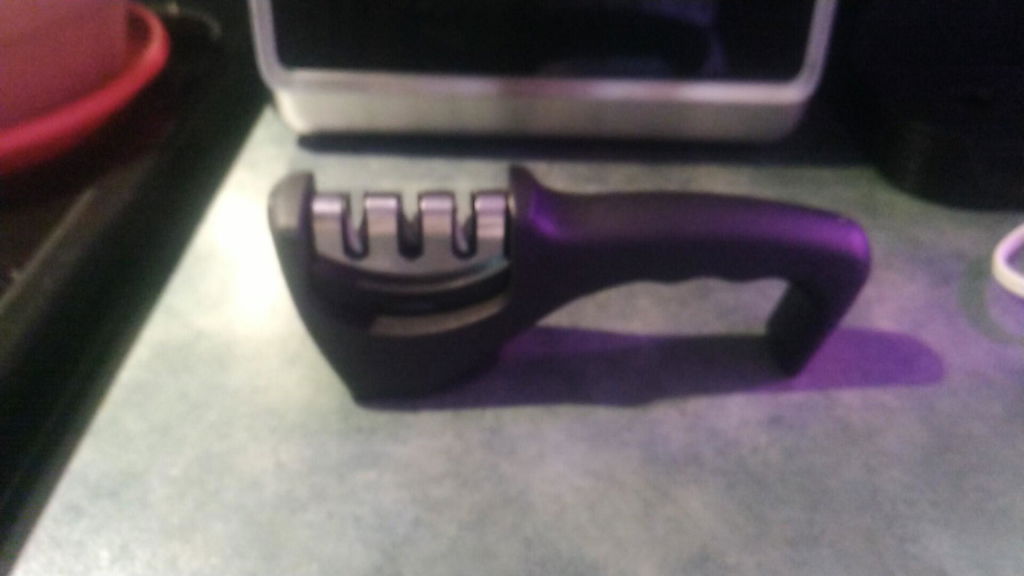
A Professional 10-Second Knife Sharpener simplifies these steps with a double pass: sharpening followed by polishing. For those who prefer a multi-stage system, the Professional Knife Sharpener offers four progressive stages.


Weight, Balance, and Ergonomics: The Criteria That Matter
Weight, balance, and ergonomics can affect fatigue while cooking. An unbalanced knife forces the wrist to constantly compensate, and this compensation turns into tension after a few dozen minutes.
Why Balance Reduces Fatigue
The principle is simple: the closer the balance point is to the hand, the less effort the wrist has to exert to keep the blade horizontal. A knife whose weight is concentrated towards the tip creates a torque that the wrist must counteract with every cutting movement. Over a 20-minute preparation, this represents hundreds of micro-corrections, hence the feeling of a heavy wrist at the end of service.
Concrete benchmarks:
- Ideal balance point: at the level of the tang, just in front of the bolster, where the index finger and thumb rest in a "pinch grip"
- Chef's knife (20 cm): 180-250 g depending on construction; below 150 g, control decreases; above 280 g, fatigue sets in quickly
- Paring knife (9-10 cm): 60-100 g, preferred for precision work
- Santoku (17-18 cm): 150-200 g, often lighter than an equivalent Western chef's knife
Weight is not the enemy: it is its distribution that matters
A heavy but well-balanced knife often cuts better than a poorly balanced light knife, because the mass of the blade works for you. The weight of the blade helps to slice without applying pressure: you let the blade fall rather than pushing it. This is particularly true for cutting squash, dense carrots, or meat with bone.
Conversely, a knife that is too light forces you to apply pressure, which causes fatigue and loss of precision. The right compromise depends on the task:
- Precision (carving, slicing): light blade, balance towards the back
- Power (slicing, deboning): heavier blade, balance slightly towards the front
- Versatility: balance at the level of the tang, medium weight
The handle matters as much as the blade
The handle transmits the efforts and conditions the grip. Three criteria to check:
- Material: stabilized wood, resin, or non-slip polymer; untreated raw wood slips once wet
- Shape: a handle that is too thin forces you to grip tightly, a handle that is too thick prevents the "pinch grip"
- Tang-handle transition: a joint without a sharp edge avoids pressure points on the index finger
A non-slip grip, even when wet, prevents slipping. This is precisely what the Japanese Knife | Ultra-Sharp offers, with its two-tone wood and resin handle that fits the palm.

Beginner or expert: which high-performance knives to choose?
The choice depends on your frequency of use, not your stated level. A beginner who cooks every day will get more out of a good knife than an expert who cooks once a month.
To choose, ask yourself three questions:
- How often do you actually cook?
- Which tasks occur most often: slicing, carving, deboning?
- Are you prepared to maintain the blade regularly?
A casual amateur can start with a single good multipurpose knife and a reliable sharpener. A demanding cook will benefit from adding a santoku or a gyuto depending on their preparations. The logic remains the same: a well-maintained high-performance tool is better than a collection of mediocre blades.
Frequently Asked Questions
Why are Japanese knives renowned for their performance?
Japanese knives use steels such as VG10, whose Rockwell hardness often reaches 60-61 HRC, allowing for a finer edge and prolonged edge retention. Their forged and hammered blade reduces food adhesion, and their acute bevel facilitates precise cuts. This combination of features explains why they are sought after by demanding cooks, even if they require careful maintenance to preserve their performance.
How does maintenance influence the lifespan of a high-performance knife?
A poorly maintained high-performance knife loses its edge in a few months. Wash it by hand, dry it immediately to prevent corrosion, and store it on a stand or in a case rather than loose in a drawer. Regular sharpening with a professional sharpener, such as those offered by Hell-kitchen-equipment, restores the edge without prematurely wearing down the blade. These simple actions extend the lifespan by several years.
Should stainless steel or carbon steel be preferred for daily use?
Stainless steel resists corrosion better and requires less maintenance, making it suitable for daily use, especially if you often cook acidic foods. Carbon steel offers a sharper edge and is easier to sharpen, but it rusts without immediate drying. For most amateur cooks, a high-quality stainless steel knife such as the Ultra-Sharp Japanese Knife from Hell-kitchen-equipment represents the best compromise between performance and ease of maintenance.
What are the risks of using low-end knives in the kitchen?
A dull knife forces you to apply pressure, which increases the risk of slipping and deep cuts. Low-end blades dull quickly, oxidize, and can even bend. The cost of frequent replacement often exceeds that of a good durable knife. Investing in a quality forged knife reduces accidents and increases efficiency on every preparation.
Choosing your knives is an investment measured in years, not seasons. Hell-kitchen-equipment supports this choice with a selection designed for performance: Japanese knives with forged or ultra-sharp blades, and professional sharpeners that bring your blades back to life. Our goal is simple: to allow you to cook faster, more precisely, and with pleasure. Discover our range and equip your kitchen with tools that stand the test of time.