Quick Summary
To clean the kitchen quickly and effectively, a non-abrasive double-sided sponge, a dish brush for crevices, and a microfiber cloth are enough to cover most needs. The choice depends mainly on the surface: the soft side for ceramic or non-stick surfaces, a brush for crevices, and microfiber for streak-free drying.
- A non-abrasive double-sided sponge covers daily dishes, with the soft side for delicate surfaces.
- The dish brush reaches the grooves of grates and the edges of baking pans that the sponge does not cover.
- A microfiber cloth allows you to wipe and dry the countertop without streaks.
- A drying rack prevents you from drying dishes piece by piece and saves time.
- On matte or lacquered laminate, avoid abrasive pads and test first on an inconspicuous corner.
Table of Contents
- Why the right utensil saves time in the kitchen
- Non-abrasive kitchen sponge: which model to choose for surfaces
- Dish brush: when it is more effective than a sponge
- Kitchen microfiber cloth: clean and dry without streaks
- Clean a countertop without damaging it: the quick method
- Drying racks and sink accessories: keep the countertop clear
- Your express cleaning routine: which utensil to take and when
- Frequently Asked Questions
Which utensils to clean your kitchen quickly and effectively?
Last updated: November 11, 2026
Why the right utensil saves time in the kitchen
The right utensil reduces the time spent properly cleaning your kitchen, often more than the amount of product used. A sponge that does not absorb well, a brush that is too rigid, or a bulky drying rack lengthens each chore. A selection of accessories designed for daily dishes allows you to reduce the back-and-forth between the sink and the countertop, with a tool adapted to each action.
The principle is a matter of practice. A double-sided sponge, a handled brush, and a microfiber cloth cover most needs. The rest is a matter of organization: keep the countertop clear to clean faster. The following sections detail each type of accessory, with the criteria that really matter.
Non-abrasive kitchen sponge: which model to choose for surfaces
A non-abrasive kitchen sponge must first absorb and release foam without scratching. The decisive criterion is the surface on which you use it: a sponge that is too abrasive damages ceramic, polished stainless steel, or non-stick pans, while a sponge that is too soft does not remove cooked residues.
For daily use, the absorbent multicolored double-sided sponge sold in a pack for €19.99 meets this need: one side for stubborn residues, the other for wiping gently. Discover the packs of absorbent multicolored double-sided sponges adapted for everyday dishes. For delicate surfaces, reserve the soft side for glassware and non-stick coatings. Consult our guide to clean a non-stick pan without damaging it.
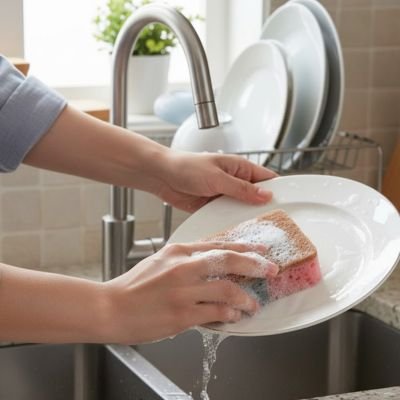
Double-sided handled sponge for burners and pots
For burners and pots with baked-on residue, a handle helps apply pressure without hurting your hand. The double-sided handled sponge, at €8.99, allows you to control the pressure and apply it where it is needed on burners and pots.
Ideal for: kitchens where burnt grease accumulates on burners and stainless steel pots. Avoid if: you only clean light dishes, a classic sponge is enough.
Dish brush: when it is more effective than a sponge
A dish brush is often more practical than a sponge for removing residues lodged in grooves, such as grates or the edges of baking pans, because its bristles reach corners that a flat sponge does not cover.
It is less suitable for fragile surfaces. On a non-stick coating or thin glass, prefer the sponge. The practical rule: brush for crevices, sponge for flat surfaces.
Kitchen microfiber cloth: clean and dry without streaks
A kitchen microfiber cloth allows you to wipe the countertop and dry surfaces without requiring an abundance of product. The principle is simple: dampen slightly, wipe, and turn the cloth when it is saturated.
Wash it separately from the dishes and replace it when the fibers fray.
Clean a countertop without damaging it: the quick method
Speed does not come from a stronger motion, but from a utensil adapted to the surface when you want to clean the kitchen without unnecessary effort. A countertop in brushed stainless steel, glass, ceramic, matte laminate, or solid wood does not react the same way to friction. The right reflex: identify the surface before choosing the sponge, brush, or cloth.
Surfaces and their limits
- Brushed stainless steel: the soft side of the double-sided sponge is well suited for delicate cleaning. Avoid abrasive pads and metal scrapers, which can scratch the surface.
- Tempered glass: the non-abrasive sponge is suitable. Avoid blades or scrapers that can scratch.
- Ceramic: the soft side of the double-sided sponge is suitable; avoid the metal brush.
- Matte or lacquered laminate: avoid repeated rubbing which can create polished areas. Use the soft sponge, without abrasive powder.
- Solid or oiled wood: avoid soaking and hard brushes.
The quick three-step sequence
- Remove dry residues with the soft side of the sponge, without rubbing.
- Pass the wet sponge with diluted dish soap (a few drops in a bowl of warm water).
- Dry immediately with a clean cloth to limit streaks.
This sequence can be quick on a standard surface, immediate drying avoiding having to go over it again.
Attention: on a matte or lacquered laminate countertop, avoid abrasive pads; always test on an inconspicuous corner before rubbing a stubborn stain.
Which utensil for which countertop
| Surface | Recommended utensil | Avoid |
|---|---|---|
| Brushed stainless steel | Double-sided sponge soft side + microfiber | Abrasive pad, steel wool |
| Tempered glass | Non-abrasive sponge + microfiber | Metal scraper |
| Ceramic | Soft sponge + microfiber | Metal brush, highly acidic product |
| Matte laminate | Microfiber + soft sponge | Abrasive powder, green side sponge |
| Oiled wood | Barely damp microfiber | Soaking, hard brush |
The ergonomic criterion that saves time
Drying racks and sink accessories: keep the countertop clear
A drying rack frees up the space where dishes pile up after washing. For small kitchens, the compact stainless steel drying rack, from €27.99, is a compact option, and the extendable model at €45.99 adapts to the amount of dishes. Discover the extendable black stainless steel drying rack, compact and space-saving.
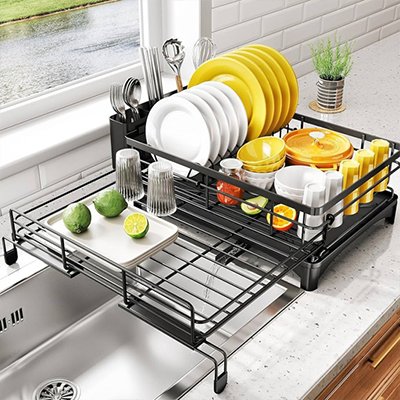
A corner drying rack at €14.99 is a space-saving option. The choice depends mainly on the available surface and the volume of dishes.
The soap dispenser, at €17.99, completes this organization by keeping dish soap within reach. A kitchen trash can, at €20.99, eliminates another back-and-forth: emptying waste without leaving the countertop.
| Accessory | Indicative price | Main use | Compatible surface |
|---|---|---|---|
| Non-abrasive sponge (pack) | €19.99 | Daily dishes | Ceramic, non-stick |
| Handled sponge | €8.99 | Burners, pots | Stainless steel, cast iron, ceramic glass |
| Compact stainless steel drying rack | €27.99 | Drying dishes | Small kitchens |
| 2-level drying rack | €61.99 | Large dishes | Standard countertops |
| Kitchen trash can | €20.99 | Daily waste | All countertops |
Indicative price
Your express cleaning routine: which utensil to use and when
A quick routine isn't about cleaning everything faster, but about performing the right actions in the right order. A salad spinner can also serve as a practical kitchen accessory to save time every day.
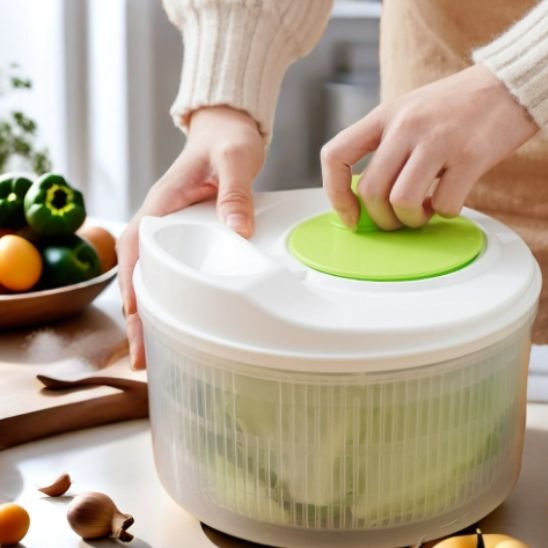
5-minute routine: everyday dishes and worktops
- Empty food scraps into the kitchen waste bin (20.99 €) or a designated bag, without leaving waste on the worktop.
- Wash plates and cutlery with a double-sided sponge (19.99 € pack), using the soft side for glassware.
- Wipe the worktop with a damp microfiber cloth, then dry with a second clean cloth.
- Let the dishes drain on the compact colander (from 27.99 €) rather than drying them piece by piece.
Actual time: 4 to 6 minutes. The time saved comes from the colander: you don't spend ten minutes drying each plate.
10-minute routine: adding pots and pans
- Start with the pots and pans while the water is still hot: the double-sided handle sponge (8.99 €) allows you to apply pressure without burning yourself and reach the bottom.
- While the pots are soaking, wash everyday dishes with the double-sided sponge.
- Use the dish brush on the grooves of the grates and the edges of baking trays, where the sponge cannot reach.
- Finish with the worktop and sink, then rinse and wring out the sponges.
Actual time: 8 to 12 minutes.
15-minute routine: deeper cleaning
- Remove the grates and removable burners, letting them soak in the sink with a little dishwashing liquid.
- Clean the inside of the oven or the walls with the dish brush and a soft sponge, without abrasive products.
- Wipe the fronts and handles with the microfiber cloth, which are often forgotten.
- Empty the colander, rinse it, and dry it to prevent limescale deposits.
Actual time: 12 to 18 minutes depending on the amount of items.
Which utensil to use according to the task and the time available
| Task | Recommended utensil | Estimated time | Why this tool |
|---|---|---|---|
| Remove cooked-on residue | Double-sided handle sponge | 2 to 3 min | The handle allows you to apply pressure without injuring yourself and reach the bottom |
| Wash everyday dishes | Double-sided sponge | 4 to 5 min | Absorbs and releases foam, with two sides to control abrasion |
| Clean the grooves | Dish brush | 1 to 2 min | The bristles reach flat corners inaccessible to the sponge |
| Wipe and dry the worktop | Microfiber cloth | 1 to 2 min | Traps light grease and prevents streaks |
| Dry the dishes | Colander | Passive | Avoids drying piece by piece |
Ergonomics: the details that change cleaning time
- The grip: a handle sponge with an ergonomic handle prevents cramps when washing heavy pots; a flat sponge forces you to apply pressure with the palm of your hand.
- Access to corners: a brush with an angled or side-bristled head reaches joints better than the same brush with a straight head.
- The weight: a compact stainless steel colander weighs less than a two-tier model; in a small kitchen, this matters when you need to move it to clean underneath.
- Drying: a sponge that does not dry well between uses retains moisture and smells bad faster.
Accessory hygiene: the forgotten step in the express routine
A sponge left damp in the sink can smell bad faster.
For your purchases, Hell-kitchen-equipment offers several of these accessories, from the double-sided sponge to the stainless steel colander.
Want to clean faster without damaging your kitchen? Hell-kitchen-equipment brings together sponges, colanders, and sink accessories designed for the daily routine.
Frequently Asked Questions
Which utensils do you need to clean a kitchen quickly?
To clean quickly, a double-sided sponge, a handle sponge for greasy areas, and a colander to free up the worktop are useful tools. The Hell-kitchen-equipment store offers the absorbent multicolored double-sided sponge for €19.99, the double-sided handle sponge for €8.99, and the compact stainless steel dish colander for €27.99.
Which sponge should you choose to clean kitchen surfaces without scratching them?
Choose a sponge with a soft side for delicate surfaces such as non-stick pans, glass, and ceramic, and reserve the abrasive side for stainless steel or cast iron pots. The double-sided handle sponge for €8.99 allows you to control the pressure on burners and pots, while the absorbent double-sided sponge for €19.99 offers a soft side for delicate surfaces. Turn the sponge over depending on the surface to avoid scratches.
Is a brush more effective than a sponge for washing dishes?
A dish brush can be useful for deep containers and corners, where a sponge does not fit as well. The sponge remains preferable for flat plates and large surfaces. In practice, the two complement each other: a sponge for the bulk of the dishes, a brush to finish the hard-to-reach parts.
How to quickly clean a worktop without damaging it?
Start by removing crumbs dry, then apply a mild product with a damp cloth. Rub in one direction, without pressing hard, then dry immediately to prevent streaks. Avoid highly abrasive sponges on laminated or varnished surfaces, which can scratch them.
How often should a kitchen sponge be replaced?
A kitchen sponge should be changed as soon as it smells bad, tears, or loses its ability to absorb water, depending on use. Rinse it well after each use and leave it to air dry. A sponge that no longer dries quickly should be replaced.