Table of Contents
- Why look for an alternative to Meilleurduchef in 2026
- Technical selection criteria for comparing online stores
- Online kitchen store comparison: what really differentiates the offers
- Professional kitchen equipment for home use: the Hell-kitchen-equipment selection
- Ergonomic kitchen accessories: the comfort that changes food preparation
- Value for money: why pay more when you're a passionate amateur
- Eco-friendly alternatives: long-term durability and maintenance
- What customer reviews reveal about alternatives to Meilleurduchef
- How to choose your equipment when you cook for passion
- Conclusion
- Frequently Asked Questions
Last updated: September 19, 2026
Why look for an alternative to Meilleurduchef in 2026
The French online kitchenware market has changed profoundly. Passionate amateurs are no longer satisfied with a generalist catalog: they want precise, durable tools and a service that understands their actual practice. This is exactly why looking for a meilleurduchef alternative has become second nature for discerning cooks.
This quest for a meilleurduchef alternative addresses three concrete frustrations. First, the difficulty of identifying the real quality of a product behind a flattering product page. Next, the feeling of paying for a brand rather than a tool. Finally, the lack of advice tailored to someone who cooks for passion, not out of professional obligation.
At Hell-kitchen-equipment, we have built our approach around a simple principle: a utensil should be judged by what it does in your hand, not by what it promises on a page. This guide compares the criteria that really matter, without marketing jargon.
Technical selection criteria for comparing online stores
Seriously comparing online kitchen stores requires forgetting the price displayed first. The criteria that determine long-term satisfaction lie elsewhere, and they start with the material, because that is what determines the lifespan, maintenance, and feel in use.
Understanding materials before comparing prices
Stainless steel. It is the foundation of most cutting and cooking utensils. It resists corrosion, does not react with acidic foods, and is easy to clean. Two types appear most often: chrome-rich steels for resistance, and carbon-enriched steels for edge retention. A well-chosen stainless steel can be resharpened indefinitely; that is its main advantage over coatings.
Forged steel. Forged hot and then quenched, it offers greater density and homogeneity than simply cut steel. The edge lasts longer and the blade withstands impacts better. The trade-off: a higher price and stricter maintenance (immediate drying to prevent pitting).
Copper. An excellent heat conductor, it distributes heat faster and more evenly than stainless steel. It is the benchmark material for delicate cooking. However, it oxidizes, requires regular maintenance, and costs significantly more. For intensive domestic use, it is often found as a core, sandwiched between two layers of stainless steel, the best performance/maintenance compromise.
Food-grade silicone. Flexible and heat-resistant, it does not scratch coatings and is easy to wash. Check: the "food-grade" mention and the absence of odor upon unpacking. Poor-quality silicone yellows and retains odors after a few months.
Wood and resin. For handles, wood offers a natural and warm grip; resin provides sealing and moisture resistance. A two-tone wood-resin handle combines both: grip even with wet hands, and durability over time.
The six criteria to check on every product page
- Material and finish: the product page must name the material (stainless steel, forged steel, food-grade silicone), not just mention it.
- Ergonomics: handle shape, blade-handle balance, non-slip grip even with wet hands.
- Stated durability: corrosion resistance, edge retention, absence of peeling coatings.
- Precision of use: cutting thickness, control of movement, stability of the tool on the work surface.
- Maintenance: ease of cleaning, compatibility with cooking methods (induction, gas, ceramic).
- Seller transparency: clear delivery times, written return policy, reachable customer service.
Which material for which intensive use
| Use | Recommended material | Why |
|---|---|---|
| Daily cutting | Stainless or forged steel | Resharpenable, resists acidity of foods |
| Delicate cooking (sauces, eggs) | Copper or three-layer stainless steel | Uniform heat distribution, no hot spots |
| Daily cooking on all heat sources | Stainless steel with thick base | Induction compatible, robust, easy maintenance |
| Contact utensils | Food-grade silicone, wood | Does not scratch, does not react with foods |
| Handles | Wood-resin | Stable grip even when wet, durable |
One criterion we too often forget: range consistency. A store that sells an excellent knife but a mediocre sharpener leaves you halfway. Consistency matters more than an isolated star in the catalog.
According to the DGCCRF, the general directorate of competition, consumption and the repression of fraud, the mandatory mentions on a product page must allow the consumer to know the essential characteristics of the item before purchase. A serious seller never leaves this information unclear, and it is the first filter of an honest comparison.
Online kitchen store comparison: what really differentiates the offers
A useful online kitchen store comparison does not rank stores by notoriety. It ranks them by what they bring to a specific buyer profile. And above all, it compares types of offers, not logos: this is the only way to remain neutral when a brand dominates the search results.
The four major business models on the market
| Offer type | What it brings | What it costs | For whom |
|---|---|---|---|
| Specialized pastry store | Technical references, complete ranges, advice | High unit prices, frequent shipping costs | Enthusiasts who want a single reliable source |
| Large professional equipment store | Very wide choice, professional brands | Order minimums, professional jargon, little support | Advanced amateurs who already know what they are looking for |
| Generalist marketplace | Low prices, fast delivery | Poor product pages, highly variable quality, possible counterfeits | Non-critical occasional purchases |
| Independent editorial selection | Few references but tested, criteria explained | Restricted choice, no in-house stock | Enthusiasts who want a filter, not a catalog |
The difference between two stores rarely comes down to the featured product. It comes down to consistency: does every item in the catalog meet the same level of standards? A store that excels on a knife but sells a mediocre sharpener leaves you halfway.
The five key trade-offs that really matter
- Breadth vs depth. A catalog of 8,000 references drowns the choice; a catalog of 40 well-documented references simplifies it. For a passionate amateur, the depth of the product page (named material, dimensions, maintenance) is worth more than volume.
- Displayed price vs cost of use. A knife at €35 resharpenable over five years costs about €7 per year. A knife at €15 whose blade becomes dull in one year costs €15 per year. The second is more expensive, not less.
- In-house brand vs third-party brands. An in-house brand guarantees range consistency but locks in renewal. Third-party brands offer flexibility but require checking every product page.
- Service vs autonomy. Written return policy, reachable customer service, announced delivery times: these elements carry more weight than a 5% discount when a tool does not fit.
- Stock vs replenishment. A reference out of stock six months a year is a bad sign for the solidity of the supply chain.
How to check a store in ten minutes
- Open three product pages at random and check that the material is named (stainless steel, forged steel, food-grade silicone), not just mentioned.
- Look for the return policy: if it is not written in black and white, consider that it does not exist.
- Check for the presence of legal notices and a real contact number.
- Compare the price of the same type of tool on two or three stores to gauge the margin level.
According to the DGCCRF, the general directorate of competition, consumption and the repression of fraud, the mandatory mentions on a product page must allow the consumer to know the essential characteristics of the item before purchase. A serious seller never leaves this information unclear, and it is the first filter of an honest comparison.
Professional kitchen equipment for home use: the Hell-kitchen-equipment selection
Professional kitchen equipment for home use only makes sense if it remains easy to use. This is the principle that guides our selection: tools designed for performance, without the complexity of restaurant equipment.

We have selected three families of tools that cover the essentials of daily food preparation: cutting, blade maintenance, and cooking.
Japanese Knives: Precision and Durability for Everyday Cutting
The Japanese Knife | Ultra-Sharp (€34.99) is our entry point for cutting. Its hammered textured blade reduces food adhesion: carrot slices no longer stick to the steel and fall directly into the dish. The high-quality stainless steel resists corrosion, and the two-tone wood and resin handle maintains its grip even when wet.

For those who prefer a blade with a more classic profile, the Japanese Knife | Forged Steel (€34.99) offers the same blade-handle balance and a hammered finish that catches the light. The weight is evenly distributed, which limits wrist strain during long food preparation sessions.
The two models share one thing in common: a clean cut that preserves the texture of the food. This is the most visible difference compared to a dull knife, which crushes instead of slicing.
Professional Sharpeners: Restore Sharpness in Seconds
A good knife is worthless without proper maintenance. The Knife Sharpener | Professional 10 Seconds (€22.99) uses a diamond abrasive in two passes: a first pass to restore sharpness and a second to polish. It works on both smooth and serrated blades and folds up to fit in a drawer.
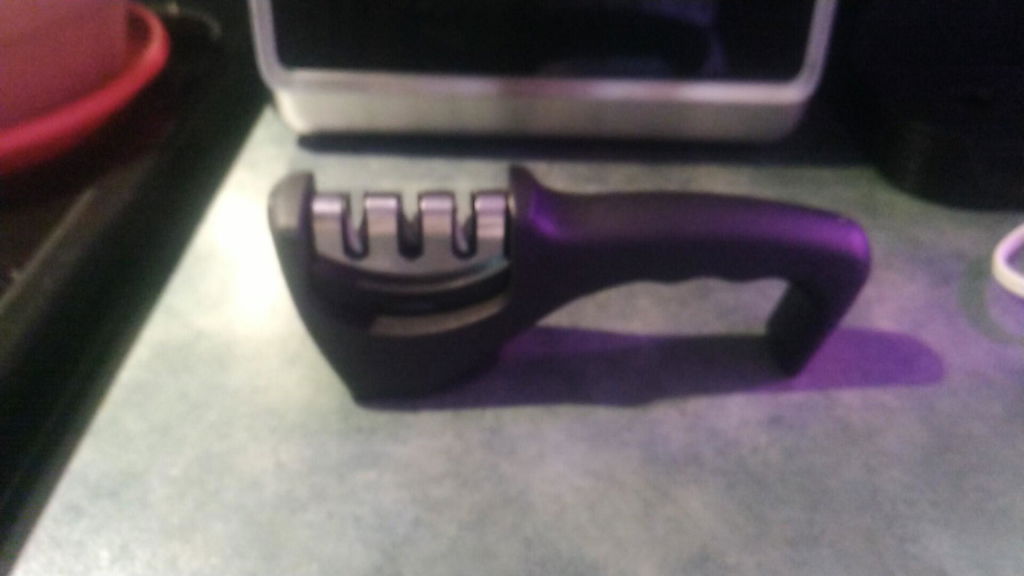
The Knife Sharpener | Professional (€25.99) takes this logic further with a four-stage system: sharpening, honing, polishing, and stropping. Each slot is numbered, making the process accessible without any special technique. The non-slip base remains stable on marble, wood, or laminate.
Premium Stainless Steel Pan: Controlled Cooking on All Heat Sources
The Premium Stainless Steel Pan (€48.99) completes the cooking selection. Its thick three-layer base distributes heat evenly, which limits burnt areas in the center and undercooked food at the edges. It is compatible with induction, ceramic, gas, and electric cooktops.
The flared edges make it easier to flip food, and the golden handle maintains a firm grip even with wet hands.
Ergonomic Kitchen Accessories: The Comfort That Changes Food Preparation
Ergonomics is the most underestimated criterion when choosing kitchen equipment. An unbalanced tool fatigues the wrist long before the end of a full meal.
Japanese Knife | Ultra-Sharp →
What really makes a difference in daily use:
- The shape of the handle: it should fit the palm, not strain it. A two-tone wood and resin handle offers a natural grip.
- The balance of weight: distributed between the blade and the handle, it guides the hand instead of forcing it.
- Stability: a non-slip base on a sharpener prevents dangerous movements during sharpening.
- Storage: a foldable format fits in a drawer, where a bulky machine would take up space.
Comfort is not a luxury. It is what determines whether you enjoy cooking or put off preparing meals.
Value for Money: Why Pay More as a Passionate Amateur
Paying more is justified when the tool lasts longer and works better. Not when it just carries a different logo.
Our selection ranges from €22.99 to €48.99. At this price point, a Japanese stainless steel knife or a stainless steel pan with a three-layer base are not luxury expenses: they are tools you will keep for several years.

The real calculation is not "how much does this utensil cost today" but "how many mediocre utensils will I have to buy to replace it". A knife that retains its sharpness and is maintained with a €22.99 sharpener often costs less over five years than a succession of cheap knives.
Eco-Friendly Alternatives: Long-Term Durability and Maintenance
The durability of a utensil is the first form of eco-friendliness in the kitchen. A tool that lasts ten years replaces ten disposable tools.
Three principles guide a more responsible choice:
- Prioritize repairable and maintainable materials: stainless steel and forged steel can be re-sharpened, unlike coatings that chip and end up in the trash.
- Maintain rather than replace: a professional sharpener allows you to keep blades in service much longer. It is the simplest anti-waste action.
- Avoid short-lived plastic: favor wood, durable resin, and metal for elements that undergo repeated stress.
A thoughtful purchase made in advance prevents overconsumption later. It is less spectacular than a label, but it is what really changes the footprint of a kitchen.
What Customer Reviews Reveal About Alternatives to Meilleurduchef
User feedback converges on one point: it is not the number of utensils that changes the experience, it is their individual quality.
What users most often notice after changing their equipment:
- The cutting sensation becomes smooth, without having to force the food.
- The disappearance of wrist strain during long food preparation sessions.
- The time saved on cutting when the blade no longer requires effort.
- The pride of presenting better-crafted dishes.
The criticisms, however, almost always focus on the same thing: product sheets that are too vague to judge before purchase. This is precisely the point we are trying to correct by detailing materials, dimensions, and uses.
To learn more about the rights you have in case of a problem, the official portal of the French administration for individuals details the legal guarantees applicable to an online purchase.
How to Choose Your Equipment When You Cook for Passion
Choosing your equipment starts by identifying the three actions you repeat most often. Cutting almost always comes first.
A simple four-step method:
- List your daily actions: cutting, slicing, searing, maintaining. These are what justify an investment.
- Prioritize cutting and maintenance: a good knife without a sharpener will become dull. The two go together.
- Check the technical criteria: named material, described ergonomics, announced cooking compatibility.
- Buy gradually: start with cutting and sharpening, then add cooking.
This progression prevents the impulsive purchase of a complete set where half is never used.
Conclusion
Equipping a kitchen when you are passionate is not about piling up gadgets, but about choosing tools that work with you. The real challenge is to find a coherent selection, where each piece maintains its level of quality without paying a price that is only justified by the brand.
At Hell-kitchen-equipment, we have built our range around three complementary families: Japanese knives with hammered blades for precision, professional sharpeners to extend the life of blades, and a premium stainless steel pan compatible with all heat sources for cooking. Each tool is designed to improve efficiency in the kitchen and make food preparation simpler, day after day.
Add the Japanese Knife | Ultra-Sharp to your kitchen and rediscover the pleasure of a clean, effortless cut.
Frequently Asked Questions
What do customers think about Meilleurduchef and its alternatives?
Customer reviews of Meilleurduchef often mention the quality of professional baking equipment but also sometimes long delivery times. Alternatives like Hell-kitchen-equipment focus on a tight selection of ergonomic accessories. Before choosing, compare the technical criteria, return policy, and user testimonials on specific products like Japanese knives or sharpeners.
How to choose your kitchen utensils when you are a passionate amateur?
Start by identifying the actions that cause you the most difficulty: cutting, sharpening, or cooking. An ultra-sharp Japanese knife at €34.99 solves most cutting problems. A professional sharpener at €22.99 extends the life of your existing blades. Complete with a premium stainless steel pan at €48.99 for cooking. Prioritize handle ergonomics, steel quality, and ease of maintenance rather than the number of utensils.
What are the best online stores for professional kitchen equipment?
The online kitchen store comparison is based on several criteria: price transparency, product sheet accuracy, return policy, and customer service. Hell-kitchen-equipment offers a range of ergonomic kitchen accessories with clearly displayed prices. Always check expert reviews and product compatibility with your existing equipment before confirming your cart.
Is Hell-kitchen-equipment suitable for the needs of amateur cooks?
Yes, the Hell-kitchen-equipment selection is designed for passionate amateurs as well as demanding cooks. The Japanese knives at €34.99 are suitable for daily use without advanced technique. The sharpeners at €22.99 and €25.99 can be used in seconds, even without experience. The premium stainless steel pan at €48.99 works on induction, gas, ceramic, and electric cooktops. No product requires special training, which makes the transition to professional-quality equipment easier.
Where to find durable and high-performance kitchen accessories online?
Look for stores that detail the materials (stainless steel, food-grade stainless steel, food-grade silicone), dimensions in centimeters, and maintenance methods. Hell-kitchen-equipment states that its Japanese knives resist corrosion. This information helps you assess durability before purchase. Avoid vague product sheets and favor stores that document technical specifications.