

Table of Contents
- What really sets a specialized kitchen store apart
- The best professional kitchen utensil brands: our selection criteria
- Induction kitchen equipment reviews: what user feedback reveals
- Unbiased technical comparison: frying pans, knives, and accessories
- Long-term durability: what changes after five years
- The right equipment for your cooking style
- Conclusion
- Frequently Asked Questions
Last updated: September 16, 2026
What really sets a specialized kitchen store apart
Choosing where to equip your kitchen involves more than comparing prices. A specialized kitchen store stands out in three ways: material traceability, genuine compatibility with your cooking method, and an after-sales service that responds when a product fails. According to the DGCCRF, the legal guarantee of conformity, all purchases benefit from a two-year legal warranty, but its application depends entirely on the seller's responsiveness.
At Hell-kitchen-equipment, we are guided by a simple principle: a poorly chosen utensil costs more than a well-chosen one.
Material selection and induction compatibility
The deciding factor remains induction compatibility: without a ferromagnetic heat diffuser, even the most expensive frying pan will not work on an induction cooktop.
18/10 stainless steel, enameled cast iron, and non-stick coating cover most needs: stainless steel resists impacts and acids, cast iron excels for slow cooking, and non-stick coating makes delicate preparations easier.
The role of after-sales service and returns
After-sales service is the true test of a store. A coating that peels in eight months, a handle that comes loose: the difference lies in how quickly the issue is addressed and how clearly the returns process is explained. Hell-kitchen-equipment offers a selection of accessories combining practicality and efficiency, from ingenious utensils to professional knife sharpeners, to make all your preparations easier.
Check the return policy and how to contact after-sales service before confirming your order.
The best professional kitchen utensil brands: our selection criteria
Identifying the best professional kitchen utensil brands means evaluating four measurable criteria: base thickness, steel type, assembly quality, and parts availability.
What distinguishes a professional range from a consumer range rarely has to do with design, but rather with consistency.
18/10 stainless steel, enameled cast iron, and non-stick coating
18/10 stainless steel contains 18% chromium and 10% nickel.
Enameled cast iron combines thermal inertia with easy maintenance, but remains heavy and sensitive to thermal shock. Non-stick coating makes cooking easier with less fat.
Thermal conductivity and heat diffusers
Thermal conductivity determines how quickly heat spreads. A three-layer heat diffuser (stainless steel, aluminum, stainless steel) distributes it evenly.
In practical terms, your food will no longer burn in the center while remaining raw at the edges.
| Criterion | What to check | Practical impact |
|---|---|---|
| Material | 18/10 stainless steel, enameled cast iron | Durability, thermal inertia |
| Base | Three-layer diffuser | Even cooking |
| Compatibility | All heat sources, including induction | Universal use |
| Maintenance | Stain resistance | Actual longevity |
Induction kitchen equipment reviews: what user feedback reveals
Reviews of induction kitchen equipment agree: disappointment almost always stems from an incompatible purchase, not a poor product.
Another finding: cheap non-stick coatings are the first to disappoint, losing their non-stick properties after a few months.
Unbiased technical comparison: frying pans, knives, and accessories
An unbiased technical comparison is based on verifiable specifications, not marketing promises. Here is the grid we use.
The four measurements that truly distinguish two utensils
1. Base thickness (frying pans and saucepans). The first figure to ask for. A three-layer stainless steel/aluminum/stainless steel base measures 2.5 to 3.5 mm, with an aluminum core of 1.5 to 2 mm.
2. Blade hardness (knives). The Rockwell C scale (HRC) is the standard. Common stainless steel ranges from 52 to 56 HRC. Between 58 and 61 HRC, the edge lasts for several weeks. Above 62 HRC, we enter the realm of traditional Japanese knives.
3. Sharpening angle. An angle of 15° per side provides a finer cut; 20° per side is the standard compromise for Western knives.
4. Throughput and residual vacuum (vacuum machines). We look at the suction rate (liters per minute) and the vacuum achieved, in millibars or as a percentage. A residual vacuum of around 99% is sufficient for cold storage.
How this applies to our range
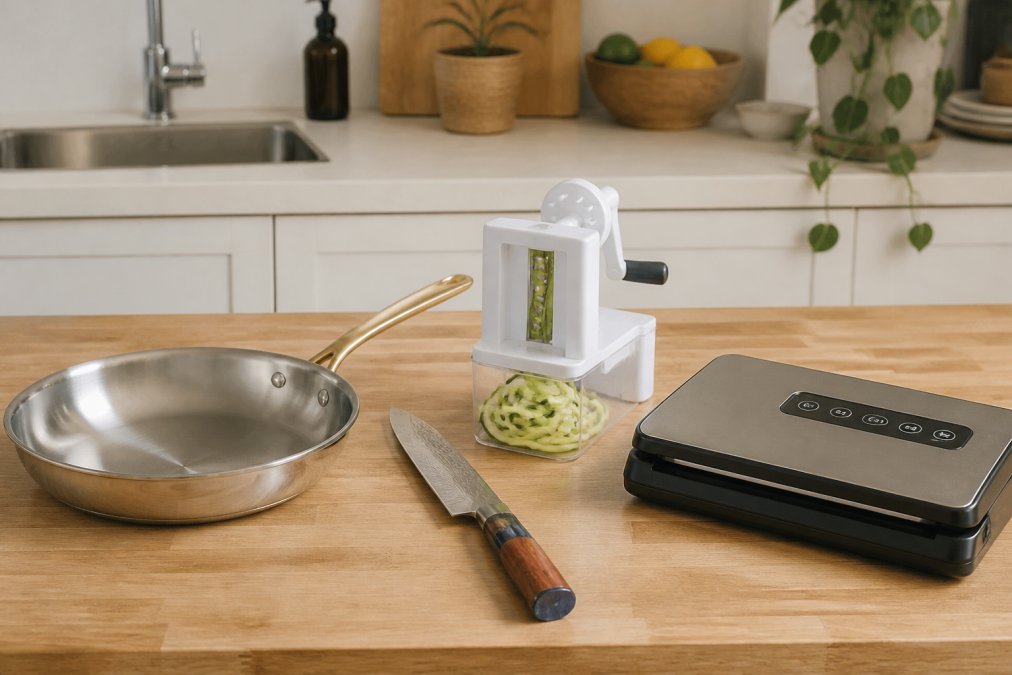
The Premium Stainless Steel Frying Pan at €48.99 works on induction, ceramic, gas, and electric cooktops, with a three-layer base and five sizes. The Ultra-Sharp Japanese Knife at €27.99 features a textured non-stick blade.
| Product | Price | Technical criterion to check | Ideal for |
|---|---|---|---|
| Premium Stainless Steel Frying Pan | €48.99 | Three-layer base thickness, all-heat-source compatibility | Searing, daily cooking |
| Japanese Knife | €27.99 | HRC hardness, sharpening angle, blade steel | Precise cuts |
| Vegetable Cutter | €28.99 | Blade type, fastening system | Spiralized vegetables |
| Vacuum Machine | €52.99 | Suction rate, residual vacuum, seal width | Batch cooking, reducing food waste |
How to compare two stores using the same criteria
Take three equivalent products (28 cm frying pan, 20 cm chef's knife, vacuum machine) and fill out the grid for each store:
- The technical sheet is complete: the store knows its products, and after-sales service will be able to identify a defect.
- The technical sheet is incomplete: you need to ask a question by email before buying, which is also a test of responsiveness.
- The technical sheet is missing: move on, regardless of the displayed discount.
Long-term durability: what changes after five years
The durability of a utensil is measured after several years of intensive use, not right out of the box. Here is what we observe for each material.
18/10 stainless steel: what holds up and what warps
18/10 stainless steel (18% chromium, 10% nickel) does not rust or react with acids.
- The base can warp if the utensil is suddenly moved from a hot burner to a cold sink. An initially flat base that "wobbles" on the burner is the first sign.
- Handle joints are the weak point. A riveted handle generally holds up better than a welded handle, especially on heavier models.
- Brown stains that appear are not rust but a buildup of burnt proteins: a bicarbonate cleaning will remove them.
Enameled cast iron: thermal shock is the enemy
Enamel does not wear down from friction but from thermal shock. Pouring cold water into a hot casserole causes micro-cracks that make the enamel shatter.
Non-stick coating: its actual lifespan
This is the material with the greatest gap between promise and reality.
- Gradual loss of non-stick properties: food begins to stick in the center, where the heat is strongest.
- Discoloration: the coating turns brown or white, a sign of degradation of the surface layer.
- Peeling: pieces come loose, generally after use with metal utensils or abrasive cleaning.
Knives: sharpness can be measured, not guessed
A knife does not wear out; it becomes dull.
The handle is the real breaking point.
Durability chart by material
| Material | Lifespan (daily use) | Wear sign to watch for | Repairable? |
|---|---|---|---|
| 18/10 stainless steel | Warped base, loose handle | ||
| Enameled cast iron | Micro-cracks in the enamel | No | |
| Standard non-stick | Loss of non-stick coating in the center | No | |
| 58-61 HRC steel knife | Handle becomes loose |
What this means for your purchase
If you cook every day, focus your budget on stainless steel and a knife, and treat non-stick cookware as a consumable. If you cook occasionally, a quality non-stick pan is enough.
What equipment suits your cooking style
The right equipment depends on your cooking style, not your budget: an occasional cook does not have the same needs as an enthusiast.
- Occasional cook: a versatile pan compatible with all heat sources and a good knife are enough.
- Regular enthusiast: add a vegetable cutter to vary your preparations and save time.
- Batch cooker: the vacuum sealer changes your weekly organization and reduces waste.
- Demanding cook: opt for 18/10 stainless steel and complementary kitchen accessories.
Conclusion
Equipping your kitchen without making mistakes requires looking beyond the price: materials, induction compatibility, after-sales service, and durability weigh much more in the long run.
Frequently Asked Questions
Is the Mathon website reliable for buying kitchen utensils?
The reliability of a kitchen store is judged on three concrete points: the clarity of the technical sheets, the existence of a written product warranty, and an accessible return policy. Always check the material composition (18/10 stainless steel, heat-diffusing base, non-stick coating) before ordering.
What are the criteria for choosing a kitchen equipment store?
Four criteria matter more than the displayed price: the quality of the cooking materials, induction compatibility, stated durability, and the clarity of the after-sales service. Add the range of products, which avoids placing multiple orders with several suppliers. Also ask if returns are accepted within 30 days.
How to compare prices between specialized stores?
Compare equal usage, not products that look similar. Relate the price to the expected number of years of use. Also look at shipping costs and sale periods, which really change the final cost of a complete cookware set.
How to check the quality of kitchen equipment before buying?
Three checks are enough. First, the weight: a utensil that is too light indicates thin steel that will warp under heat. Next, the technical sheet: look for the 18/10 stainless steel mention for pots and the thickness of the heat-diffusing base. Finally, read customer reviews about durability after several months, not just about delivery.
