Table of Contents
- Why Japanese knives transform your kitchen
- Types of Japanese knives and their specific uses
- Choosing a knife according to your needs and budget
- How to properly sharpen a Japanese knife
- Daily care for Japanese knives
- Safety, grip, and ergonomics
- Summary table: choosing your Japanese knife
- Frequently Asked Questions
Last updated: October 8, 2026
Why Japanese knives transform your kitchen
Japanese knives offer a significantly superior cut compared to traditional Western knives thanks to their precise design and distinct blade geometry.
The difference lies in the design philosophy: where Western knives balance slicing and chopping, Japanese knives prioritize a clean and precise cut.
This guide covers everything you need to know to choose, use, and care for your Japanese knives, and why the investment is worth every penny.
Types of Japanese knives and their specific uses
Japanese knives come in several profiles, each optimized for a particular task. Understanding these differences allows you to choose the right tool for your cooking style.
The santoku knife: versatility and precision
The santoku knife is the ultimate versatile knife. Its name means "three virtues," referring to its ability to slice meat, fish, and vegetables with equal efficiency. Its typical length of 170 to 180 mm balances control and cutting surface.
Its flat-profile blade, slightly curved toward the tip, allows for slicing or vertical pressure cutting. Sharpened to about 15 degrees on each side, the edge offers superior retention while remaining easy to sharpen at home.

The gyuto knife: the Japanese chef's knife
The gyuto knife is the Japanese counterpart to the Western chef's knife, with a different cutting philosophy.
Its blade, thinner and lighter than its Western counterpart, has a straighter profile that facilitates vertical cuts. The sharpening angle, between 15 and 17 degrees, ensures exceptional edge retention.
The gyuto excels at tasks that require range and finesse: carving a whole poultry, slicing vegetables, or preparing thin slices of meat. Professionals and serious amateurs favor it for its consistent precision.
Nakiri and other specialty knives
The nakiri knife is specialized in cutting vegetables. Its wide, flat rectangular blade resembles a small cleaver: it slices effortlessly while protecting the fingers thanks to its natural guard.
Unlike the santoku or gyuto, the nakiri is not suitable for meat: its flat blade is not designed for bones.
Other specialized knives complete the Japanese range:
- Yanagiba: long, thin knife for slicing raw fish (sashimi). Its 240 to 300 mm blade allows for clean and fluid cuts.
- Sujihiki: meat carving knife, with a thin and pointed blade for even slices.
- Petty: 150 mm paring knife, ideal for precision tasks and small ingredients.
- Deba: sturdy knife for preparing whole fish, with a thick blade capable of handling bones.

Choosing a knife according to your needs and budget
Selecting the right Japanese knife depends on three factors: your cooking habits, frequency of use, and your budget. Thoughtful investment avoids regrets and impulsive purchases.
Blade length and shape
Blade length directly influences comfort and efficiency: too short, it multiplies knife strokes; too long, it becomes difficult to control on a small work surface.
For compact kitchens or small hands, a 170 mm blade offers a good balance; for spacious kitchens or ambitious preparations, 210 mm becomes necessary.
Blade shape also affects technique: a straight profile (gyuto) favors vertical cutting, a slightly curved profile (santoku) allows for rocking and pressure, a rectangular blade (nakiri) excels at vertical chopping.
Steels and hardness: edge retention versus maintenance
The steel used determines the edge's durability and ease of maintenance. Two major families dominate Japanese knives: stainless steel and homogeneous carbon steel.
Japanese knife | Ultra-sharp →

Stainless steel offers acceptable edge retention with minimal maintenance. Resistant to corrosion and stains, it is suitable for wet kitchens or cooks who are less inclined toward maintenance.
Homogeneous carbon steel offers superior edge retention and easier sharpening.
For beginners or busy cooks, stainless steel is the pragmatic choice. For enthusiasts willing to invest time in maintenance, carbon steel offers a superior cutting experience.
How to properly sharpen a Japanese knife
A Japanese knife without an edge is merely a frustrating utensil. Regular sharpening keeps it at its maximum potential and extends its lifespan, without requiring special skills or expensive equipment.
Sharpening frequency and signs of wear
Sharpening frequency depends on use: an amateur who uses their knife three to four times a week should sharpen it every two months, a professional who uses it daily every week, or even twice a week depending on the hardness of the steel.
Several signs indicate that it is time to sharpen:
- The knife slides over the skin of a tomato instead of slicing it cleanly
- You have to press harder to get the same cut
- The blade makes a muffled sound instead of a dry sound when cutting
- Vegetables are slightly crushed instead of being cleanly sliced
The tomato test remains the most reliable: try to lightly cut a ripe tomato without pressing. A well-sharpened knife goes through the skin effortlessly; a dull knife slides or crushes.
Sharpening methods: whetstone, steel, and compact sharpener
Three main methods allow you to sharpen a Japanese knife. Each offers a different compromise between efficiency, cost, and ease of use.
The whetstone offers maximum control and the cleanest results.
The sharpening steel straightens the blade's edge without removing material. Contrary to popular belief, the steel does not sharpen: it realigns.

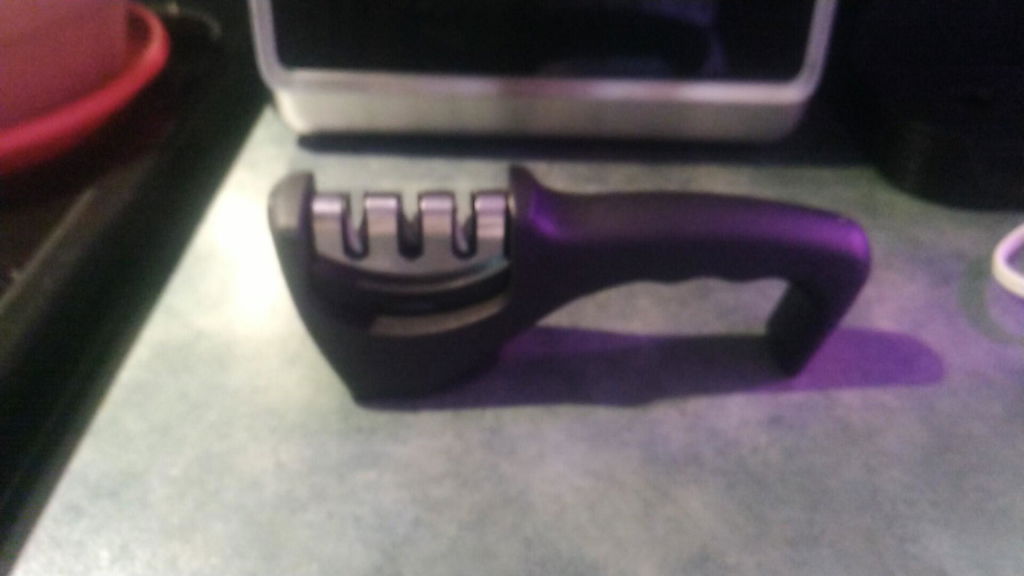
The compact sharpener combines sharpening and finishing in a single tool. Two slots allow you to restore the edge (first slot) and then polish (second slot). The advantage: simplicity and speed.
A wooden roller sharpener, like the 15° angle wooden roller sharpener, combines stability and aesthetics.
Daily care for Japanese knives
Daily care determines the longevity of your knife: a few simple steps prevent irreversible damage and keep it in optimal condition.
Cleaning, storage, and blade protection
After each use, clean your knife with warm water and mild soap using a sponge or soft cloth, never an abrasive, then dry it completely.
Never put your knife in the dishwasher. Harsh detergents and impacts damage the blade and handle. Hand washing takes a minute and protects your investment.
Storage deserves the same attention as cleaning. Three options:
- Storage block: protects the blade and organizes your space. Make sure the slots are wide enough not to rub the blade.
- Magnetic bar: wall-mounted, it keeps your knives accessible and protected. Check that the magnet is not too weak.
- Sheath or blade protector: ideal for transport or drawer storage. Make sure it does not retain moisture.
Avoid storing your knife loosely in a drawer. Contact with other utensils dulls the blade and risks breaking it.
Japanese knife | Ultra-sharp →
For carbon steels, occasionally apply a thin layer of mineral oil or petroleum jelly to the blade to prevent rust, then wipe off the excess with a dry cloth.
Safety, grip, and ergonomics
A well-sharpened Japanese knife is paradoxically safer than a dull knife. A clean blade glides without resistance, reducing the risk of slipping and cutting.
The correct grip prevents injuries and improves your control. Three grips dominate:
The chef's grip: the thumb and index finger encircle the handle just above the guard. The other three fingers grip the handle. This grip offers power and control for broad movements.
The handle grip: all fingers grip the handle. This grip is suitable for repetitive movements and vertical cutting.
Handle ergonomics affect fatigue and safety: too short, it forces the hand to contract; too long, it becomes difficult to control.
Handle material also matters. Wood offers a warm and natural grip. Synthetic resin offers durability and ease of cleaning.
Summary table: choosing your Japanese knife
| Knife type | Blade length | Recommended steel | Best for | Maintenance |
|---|---|---|---|---|
| Santoku | 170-180 mm | Stainless or carbon | Versatility, vegetables and meat | Minimal (stainless) |
| Gyuto | 210 mm | Carbon for precision | Large cuts, filleting | Regular (carbon) |
| Nakiri | 180 mm | Stainless preferred | Vegetables, vertical chopping | Minimal |
| Yanagiba | 240-300 mm | High-carbon steel | Sashimi, thin slices | Regular |
| Petty | 150 mm | Stainless or carbon | Precision tasks, fruit | Minimal |
Choosing a Japanese knife is an investment in your daily culinary enjoyment and the quality of your preparations: properly maintained, it will serve you for years.
Hell-kitchen-equipment offers a selection of Japanese knives and professional sharpeners designed to transform your cooking experience. Our range of ultra-sharp Japanese knives combines a stainless steel blade with a two-tone wood and resin handle for the perfect balance of performance and durability.
Start with a santoku or gyuto suited to your style, then gradually expand your collection according to your needs: each knife added opens up new possibilities and refines your technique.
Frequently Asked Questions
What is the best Japanese knife for everyday cooking?
The santoku knife or gyuto knife is perfectly suited for everyday use. The santoku excels at precisely slicing vegetables thanks to its flat profile, while the gyuto offers more versatility for meats and vegetables. The choice depends on what you prepare most often. A 17 to 18 cm blade is sufficient for most home kitchens. Hell-kitchen-equipment's ultra-sharp Japanese knives combine stainless steel with an ergonomic handle for optimal comfort.
What is the difference between a santoku knife and a gyuto knife?
The santoku (17 to 18 cm blade) has a flat profile with a rounded tip, ideal for vegetables and slicing techniques. The gyuto (210 mm blade or larger) resembles a Western chef's knife with a tapered tip, offering more versatility for slicing meat, fish, and vegetables. The santoku excels at precise vertical cutting, while the gyuto also allows for a rocking motion. For beginners, the santoku is often more intuitive.
How do you sharpen a Japanese knife without damaging the blade?
Use a sharpening stone at a 15° to 17° angle, or opt for a wooden roller sharpener like the one from Hell-kitchen-equipment, which automatically guides the angle. Pass the blade 10 to 15 times on each side, from heel to tip, with a smooth motion. For regular maintenance between sharpenings, a steel sharpening rod straightens the blade's edge in a few passes. Sharpen every 3 to 6 months depending on use.
Which steel should you choose for a Japanese knife: stainless or carbon?
Stainless steel resists corrosion better and requires less maintenance, making it ideal for wet kitchens. Carbon steel offers better edge retention and is easier to sharpen, but requires regular maintenance to prevent rust. For home use, stainless steel is recommended. Hell-kitchen-equipment's Japanese knives use high-quality stainless steel with a hammered finish to combine durability and performance.
Is a Japanese knife suitable for cooking beginners?
Yes, absolutely. Japanese knives are excellent for beginners thanks to their sharp blade that cuts without force, reducing the risk of slipping. The santoku in particular, with its stable blade and natural balance, makes it easier to learn cutting techniques. A good compact sharpener completes the equipment. Hell-kitchen-equipment's ultra-sharp Japanese knives offer an excellent starting point with a comfortable two-tone handle.
How do you maintain a Japanese knife so that it lasts a long time?
Clean immediately after each use with warm water and soap, then dry it. Store it horizontally or in a knife block, never in a drawer where it would clatter against other items. Avoid the dishwasher and hard surfaces like marble. Sharpen regularly every 3 to 6 months depending on use. With this simple maintenance, your knife remains high-performing for years.