Table of Contents
- Carbon steel vs stainless steel: the differences that change everything about maintenance
- Comparison table: carbon steel vs stainless steel blade maintenance
- Pros and cons of carbon steel for everyday use
- Pros and cons of stainless steel for everyday use
- How to sharpen a carbon steel knife without damaging it
- Protecting a carbon steel blade against rust: essential steps
- Best professional kitchen knife sharpener: how to choose
- HRC hardness, corrosion, and food safety: what really changes maintenance
- Conclusion
- Frequently Asked Questions
Last updated: September 20, 2026
Carbon steel vs stainless steel: the differences that change everything about maintenance
Blade maintenance depends first on a single factor: the composition of the alloy. Carbon steel contains very little chromium and a lot of carbon, which gives it a razor-sharp edge but makes it vulnerable to oxidation. Stainless steel adds a significant amount of chromium, often supplemented with molybdenum, which slows corrosion at the cost of a slightly less aggressive edge.
This chemical difference explains everything else. A carbon steel knife requires immediate wiping after each use, a thin layer of oil, and storage away from moisture. A stainless steel knife tolerates more neglect, but it also dulls faster on acidic foods and bones.
The answer is never universal.
The point that most guides forget: it is not the metal that determines the durability of your knife, it is the consistency of your routine. A carbon steel knife wiped every evening will outlast a stainless steel knife left wet in the drying rack.
Comparison table: carbon steel vs stainless steel blade maintenance
Here is a summary of the practical differences between the two families of steel. This table summarizes what we detail section by section.
| Criterion | Carbon steel | Stainless steel |
|---|---|---|
| Rust resistance | Low, requires immediate drying | High thanks to chromium |
| Edge retention | Long, razor-sharp edge | Moderate, dulls faster |
| Ease of sharpening | Very easy, soft metal | More difficult, abrasive metal |
| Daily maintenance | Systematic wiping + oil | Wash then dry carefully |
| Patina | Develops naturally | None, stable appearance |
| Ideal for | Precise cooking, fine cutting | Versatile everyday use |
The deciding factor remains the frequency of use. A stainless steel knife used every day will require less attention. A carbon steel blade reserved for fine cuts will give you a sharpness that stainless steel will never achieve.
Pros and cons of carbon steel for everyday use
Carbon steel appeals because of its sharpness. The metal, which is softer after heat treatment, can be sharpened on a whetstone in a few minutes and regain a razor edge. Discerning cooks appreciate this responsiveness: the blade bites into the tomato without crushing it.
Its limitations are just as clear:
- It rusts on contact with water, even a few minutes are enough
- Acidic foods (lemon, vinegar, onion) attack the surface and leave gray marks
- Patina appears quickly and is disliked by those who want a flawless blade
- It never withstands the dishwasher
One point that most guides forget: patina is not rust. It is a protective oxide layer that forms over time and slows corrosion. Many cooks mistake it for a defect and rub too hard, damaging the surface.
Pros and cons of stainless steel for everyday use
Stainless steel wins on peace of mind. Thanks to the chromium in the alloy, it resists corrosion in normal use and withstands a quick wash without consequence. It is the steel of modern Japanese knives and the majority of kitchen blades sold today.

Its weaknesses lie in its hardness. Well-treated stainless steel holds its edge longer than we think, but it becomes more difficult to sharpen by hand. You have to insist more on the stone or use a pre-set angle sharpener.
The real trap is false security. "Stainless" does not mean "unalterable". A knife left for hours in soapy water eventually marks, especially at the blade near the handle where moisture stagnates.
- Tolerates oversights and quick washes better
- Does not develop a patina, constant appearance over time
- Requires more frequent sharpening to maintain a perfect edge
- Remains sensitive to impacts on the edge, which chips on bones and frozen foods
How to sharpen a carbon steel knife without damaging it
To sharpen a carbon steel knife, work at a constant angle, lubricate the stone, and alternate faces. Soft steel forgives angle errors, but it wears out quickly if you force it.
The five-step method:
- Soak the whetstone in water for about ten minutes
- Place the blade at 15-20 degrees, without pressing
- Perform regular passes, ten per face, keeping the same angle
- Alternate faces until you feel a biting edge under your thumb
- Rinse, dry immediately, then oil the blade
The gesture that most often fails: pressing too hard. On a carbon blade, excessive pressure digs into the metal and unbalances the profile. Let the stone do the work, your hand only guides.
If you don't have the patience for the stone, a pre-set pass sharpener does the job in thirty seconds. It is a solution for everyday blades, provided you respect the indicated number of passes.
Protecting a carbon steel blade against rust: essential steps
The protection of a carbon steel blade rests on a simple principle: prevent water and oxygen from staying in contact with the metal. Carbon steel contains almost no chromium, the element which, in stainless steel, forms a passive and self-repairing oxide layer. Without this natural shield, it is up to you to create it, through drying, oil, and controlled storage.

The three steps, in order
- Rinse with warm water without aggressive detergent or abrasive sponge, immediately after use. No soaking, never.
- Dry immediately with a soft cloth, including the silk and the junction with the handle where moisture stagnates. Do not let air dry: evaporation deposits minerals that start pits.
- Oil in a thin layer over the entire blade, then wipe off the excess with absorbent paper. A layer too thick retains dust and goes rancid.
Which oils to use concretely
Not all oils are equal for prolonged storage. The deciding criterion is oxidation stability: an oil that goes rancid leaves a sticky and acidic film that attacks the blade instead of protecting it.
- Food-grade mineral oil: the reference in cutlery. Odorless, tasteless, it does not go rancid and remains stable for months. It is the default choice for a knife stored for a long time.
- Camellia oil (tsubaki): traditional on Japanese knives, it protects without leaving a greasy film and remains fluid at low temperatures.
- Vaseline oil / paraffin oil: equivalent to mineral oil, very common in hardware stores, economical and effective.
- Classic food oils (sunflower, rapeseed, olive): acceptable for everyday use if the blade is frequently re-wiped, but they eventually go rancid. Avoid for storage of several weeks.
- Microcrystalline wax or beeswax: solid alternative for exposed blades or collections. It forms a more durable film than oil but requires a slight warming to apply.
Storage: what accelerates rust
Ambient moisture is the main enemy. A magnetic block fixed above the cooktop exposes the blade to steam at every cooking. A closed drawer, a wooden case or a treated felt sheath limits exchanges with humid air. For long-term storage, a desiccant packet (silica gel) slipped into the drawer maintains a low humidity rate.
Japanese Knife | Ultra-Sharp →
Restoring a blade that has already oxidized: the step-by-step method
When rust is established, it must be removed mechanically before protecting again. Here is the sequence that works on surface oxidation (light to moderate rust):
- Assess the extent: superficial rust (orange film) is treated by hand; pitted rust (craters) requires more patience and can leave permanent marks.
- Degrease the blade with hot water and mild dish soap, then dry.
- Attack the rust with progressive abrasive: 400 grit sandpaper to start, then 800, then 1000-1200 to polish. Always in the direction of the blade, never across, to avoid scratching deeply.
- Gentle chemical alternative: a paste of baking soda and water, or white vinegar applied locally with a cloth, dissolves light oxidation. Rinse thoroughly and dry immediately.
- Neutralize and protect: once the blade is clean and dry, apply a thin layer of mineral oil. The grey patina that subsequently reforms is protective, not a defect.
Patina: an ally, not an enemy
Patina is a stable oxide layer that gradually forms through contact with acidic foods and air. Unlike rust (hydrated iron oxide, powdery and destructive), patina adheres and slows corrosion. Many cooks mistake it for a defect and rub too hard, damaging the surface. A uniform, grey or bluish patina is the sign of a well-maintained blade.
Best professional kitchen knife sharpener: how to choose
The best professional kitchen knife sharpener is one that respects the angle of your blade without removing too much material. A good sharpener restores the edge in a few passes and stores away without taking up the entire drawer.
Three criteria determine the choice:
- The preset angle: a sharpener with guide slots guides the blade and prevents hand errors
- The abrasive: diamond lasts for years, ceramic polishes more finely
- Stability: a non-slip base prevents slips that damage the edge
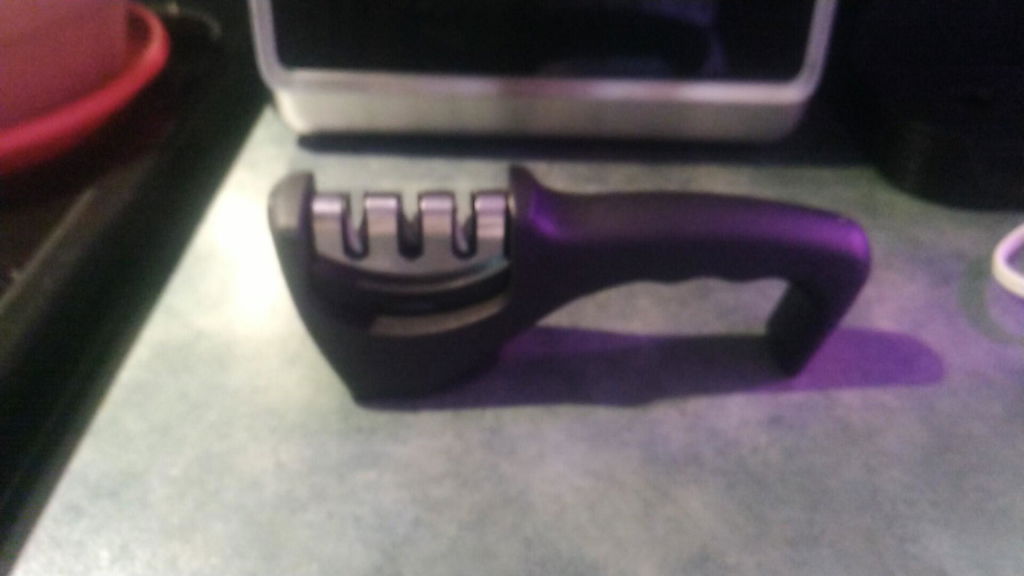
For regular household use, a compact two- or three-step model is more than sufficient. Four-stage systems are suitable for those who want to sharpen, hone, polish, and rectify without changing tools.

Our selection at Hell-kitchen-equipment meets this need exactly:
| Product | Price | Steps | Ideal for |
|---|---|---|---|
| Professional 10-Second Knife Sharpener | €22.99 | 2-in-1, foldable | On-the-go use, camping, small drawer |
| Professional Knife Sharpener | €25.99 | 4 stages | All types of blades, intensive use |
| Professional Knife Sharpener (3 steps) | €25.99 | 3 stages | Restoring very dull blades |
The foldable sharpener at €22.99 is the most versatile for those short on space. The 4-stage model is suitable if you sharpen several knives at once, including kitchen shears.

HRC hardness, corrosion and food safety: what really changes maintenance
HRC hardness (Rockwell C) measures steel's resistance to penetration. It stems directly from heat treatment, quenching then tempering, and determines both edge retention and blade fragility. Understanding this scale allows you to choose a knife based on the maintenance you are prepared to give it.
What HRC changes concretely
- 54-56 HRC: soft steel, sharpens in a few minutes on a stone, but the edge dulls quickly and deforms (rolls) rather than chipping. Ideal for those who want to maintain it by hand without effort.
- 57-59 HRC: common compromise on versatile kitchen knives. Good edge retention, sharpening still accessible.
- 60-62 HRC: range of high-end Japanese knives (Gyuto, Santoku in carbon steel like Shirogami or Aogami). Exceptional sharpness, but brittle blade: a shock on a bone or frozen food can chip the edge. Longer sharpening, steeper angle (15° per side).
- 63 HRC and above: reserved for powder steels (like SG2/R2, ZDP-189). Extreme edge retention, but difficult sharpening and high sensitivity to shocks. Reserved for experienced users.
The point most guides forget: high hardness does not make the blade "better", it shifts the slider between edge retention and ease of maintenance. A 62 HRC knife poorly used will wear out faster than a 56 HRC knife well treated.
Corrosion: the 10.5% chrome threshold
The corrosion resistance of stainless steel does not come from a surface treatment but from its composition. For steel to be considered "stainless", it must contain at least 10.5% chrome by mass. This chrome reacts with oxygen in the air to form a passive layer of chromium oxide, invisible, adherent, and self-repairing: if scratched, it reforms instantly in the presence of oxygen.
Molybdenum, added as a complement (often 1 to 3%), improves resistance to chlorinated and acidic environments, this is the case of so-called "18/10" steels or Japanese steels like VG-10. Carbon steel, meanwhile, generally contains less than 1% chrome: no passive layer can form, hence the need for external protection (oil, wax, patina).
Food safety: what you really need to know
The most frequent fear concerns the transfer of metallic taste and the hygiene of carbon blades in the kitchen.
- Metallic taste: an unprotected carbon blade, in prolonged contact with acidic foods (lemon, vinegar, tomato, onion), can release iron ions that give a metallic taste and turn the food black. The solution is simple: cut, serve, wipe, without leaving the blade resting on the food.
- Hygiene: a clean, wiped, and oiled blade remains hygienic regardless of the steel. The risk comes from a rusted or pitted blade: the crevices hold food residues and complicate cleaning. Surface rust can be removed; a deep pit requires reforming the profile or replacing the blade.
- Stainless steel chrome limits the exchange between the metal and the food, making it a safer choice for acidic preparations or long marinades.
- Patina is not a health risk: it is a stable, adherent oxide that does not detach into the food.
Usage guidelines according to HRC and steel
| Usage | Recommended HRC | Suitable steel | Maintenance required |
|---|---|---|---|
| Versatile daily cooking | 54-57 | Stainless steel type X50CrMoV15 | Washing + drying, regular sharpening |
| Precise cooking (vegetables, fish) | 58-61 | Carbon steel type Shirogami/Aogami or VG-10 stainless | Immediate wiping, oiling, sharpening on stone |
| High-end fine cutting | 61-63 | Powder steel SG2/R2 | Shock precautions, expert sharpening |
| Outdoor / hunting | 55-58 | Tough carbon or stainless | Systematic oiling, frequent sharpening |
This table is not a quality ranking: each range corresponds to a use and a level of commitment. A 56 HRC knife well maintained will cut better than a 62 HRC left wet in the drying rack.
Conclusion
Choosing between carbon and stainless steel comes down to choosing your level of commitment. Carbon rewards rigor with a superior edge, stainless steel rewards simplicity with outstanding resistance.
Whatever your blade, regular sharpening remains the key to clean cutting. At Hell-kitchen-equipment, we offer professional sharpeners with a preset angle, a stable non-slip base, and a compact format that stores anywhere.
Frequently Asked Questions
What is the difference between carbon steel and stainless steel?
Carbon steel contains mainly iron and carbon, without significant added chrome. It offers a sharp edge that is easy to sharpen, but fears moisture and acidic foods. Stainless steel incorporates at least 10.5% chrome, which forms a protective layer against oxidation. It requires less daily maintenance, but its edge retention is generally lower and its sharpening more demanding. The choice therefore depends on your tolerance for maintenance.
Does carbon steel systematically rust when in contact with acidic foods?
No, not systematically. An unprotected carbon steel blade can mark or oxidize after prolonged contact with tomatoes, lemon, or vinegar, but a properly maintained blade resists these short contacts. The key reflex: wipe the blade immediately after use, without letting it air dry. A thin layer of food oil applied after drying also limits the risks. The patina that gradually forms also partially protects the steel.
Why does a carbon steel blade require specific maintenance?
Carbon steel has no chrome to block oxidation. Moisture, hand sweat, and acidic residues directly attack the metal. Without quick wiping and oil protection, rust appears in a few hours in a humid environment. In return, this same absence of chrome gives a finer edge that is easier to restore. Carbon steel blade maintenance therefore relies on three simple steps: wipe, dry, oil after each use.
How to effectively clean and protect a carbon steel blade?
Wash the blade by hand, in warm water, with a little dish soap and a soft sponge. Avoid the dishwasher, which combines heat, moisture, and aggressive detergents. Dry immediately with a clean cloth. For carbon steel blade protection against rust, apply a thin layer of food oil (sunflower, camellia) over the entire surface. Store the knife on a magnetic holder or in a case, never in a damp drawer. Renew the oiling every two to three weeks with regular use.
Which sharpener to choose for a carbon or stainless steel knife?
For regular maintenance at home, a manual guided-stroke sharpener saves time without risking damage to the blade's geometry. The Hell-kitchen-equipment Professional 10-second knife sharpener, priced at €22.99, works on both smooth and serrated blades with a preset angle. For more comprehensive sharpening, the Professional knife sharpener (€25.99) features a multi-stage system that straightens, sharpens, and polishes. These tools are suitable for both types of steel.