Table of Contents
- Professional vs Classic Knives: What Really Changes
- The Comparison Chart: Professional, Intermediate, Classic
- Carbon Steel vs Stainless Steel: Which Metal for Which Use
- Forged Knife vs Stamped Knife: Two Ways to Be Born
- The Blade Profile: The Detail Pros Look at First
- The Handle and Balance: What Your Wrist Feels
- How to Sharpen Your Knives: The Maintenance That Separates the Two Categories
- Lifespan and Real Cost: What You Pay Over Ten Years
- Are Japanese Knives Professional Knives?
- How to Choose According to Your Cooking Style
- Frequently Asked Questions
Last updated: September 20, 2026
Professional vs Classic Knives: What Really Changes
The difference between professional and classic knives lies first in the steel, the blade profile, and the balance of the handle. A classic supermarket knife cuts. A professional knife works for you, stroke after stroke, without your wrist paying the price.

This distinction deserves a closer look, because it comes down to details that no one looks at in the store.
This comparison breaks down the six criteria that truly separate the two families: metal, manufacturing, profile, handle, sharpening, and cost over ten years. You will then know which camp suits you, without paying for features you don't need.
The Comparison Chart: Professional, Intermediate, Classic
Three categories coexist on the market, and the confusion almost always comes from the middle of the chart. Here is what concretely distinguishes them.
| Criterion | Classic | Intermediate | Professional |
|---|---|---|---|
| Steel | Low-end stainless | Food-grade stainless | Carbon steel or high-hardness stainless |
| Manufacturing | Stamped | Improved stamped | Forged |
| Spine thickness | Thin and flexible | Medium | Thick or tapered |
| Handle | Molded plastic | Simple wood or resin | Fitted wood and resin |
| Sharpening | Difficult, holds little | Good | Clean, durable |
| Lifespan | 2 to 5 years | 5 to 10 years | 15 years or more |
The deciding line is manufacturing. A stamped knife is cut from a sheet of steel, then ground. A forged knife is worked hot, which densifies the metal structure and allows for a thicker spine profile.
This thickness changes everything when cutting. A thin spine vibrates, a thick spine guides.
Carbon Steel vs Stainless Steel: Which Metal for Which Use
The choice of metal determines maintenance, not the grade. Poorly maintained carbon steel rusts in a few days. Poorly sharpened stainless steel cuts poorly. Both require a different discipline.
Carbon Steel: Extreme Bite, Strict Maintenance
Carbon steel takes a more aggressive edge and re-sharpens in a few passes. It oxidizes on contact with water and acidic foods. It must be wiped immediately after use and the blade oiled regularly.
This metal is suitable for those who cook every day and are willing to take care of it. For occasional use, it's a source of frustration.
Stainless Steel: The Everyday Balance
Stainless steel resists corrosion and can withstand occasional dishwasher use, even if hand washing remains preferable. It holds its edge less long than well-maintained carbon steel, but it forgives forgetfulness.
For the majority of cooks, stainless steel is the default choice. The two Japanese knives in our selection use high-quality stainless steel, designed to last without rusting.
Forged Knife vs Stamped Knife: Two Ways to Be Born
A forged knife is shaped from a heated and hammered steel bar. A stamped knife is cut from a sheet, like a cookie cutter. The method changes the density of the metal and the final shape of the blade.
Forging allows for a full tang, meaning a metal part that runs the entire length of the handle. The knife becomes heavier, more stable, and its balance naturally falls under the index finger.
Stamping produces a light knife, often cheaper, with a partial tang. It is suitable for light tasks and small hands. It tires faster on long cuts.
This is the first thing I check when someone shows me their knife: the line between the blade and the handle. If it is clean and continuous, the knife was forged. If it is flat, it was stamped.
The Blade Profile: The Detail Pros Look at First
The blade profile is the curve of its cutting edge seen from the side. It determines the type of cut possible: belly for chopping, straight line for slicing, fine tip for detailing.

A professional chef's knife combines three zones on a single blade. The heel, near the handle, is used to chop herbs and nuts. The middle works in balance for vegetables. The tip carves shallots and fish.
A classic knife often offers a single, soft curve. It cuts, but it forces you to lift the blade between each slice. On a preparation of carrots, this represents dozens of unnecessary movements.
The hammered finish, visible on some Japanese knives, adds a texture that reduces food adhesion. Cucumber slices fall instead of sticking to the steel.
The Handle and Balance: What Your Wrist Feels
The balance of a knife is measured at the point where it tips on your extended finger. On a professional knife, this point falls just in front of the handle, under the index finger. On a classic, it often falls back into the handle.
This difference seems minor. It is not. A knife heavy in the handle forces you to grip tighter to compensate. After twenty minutes of cutting, tension builds up in the forearm.
The two-tone wood and resin handle, common on Japanese knives, combines warmth to the touch and grip even when wet. A molded plastic handle slips as soon as hands are greasy.
Also check the shape. A handle that is too thin forces you to hold it in a pinch, which cramps the fingers. A handle that is too thick prevents you from wrapping your fingers properly around it.
Japanese Knife | Ultra-Sharp →
How to Sharpen Your Knives: The Maintenance That Separates the Two Categories
A poorly sharpened professional knife cuts less well than a well-maintained classic. The difference between the two families only reveals itself when maintenance is equal.
The manual method with a stone gives the best result, but it requires holding a constant angle. This is where most people give up, and it is understandable.
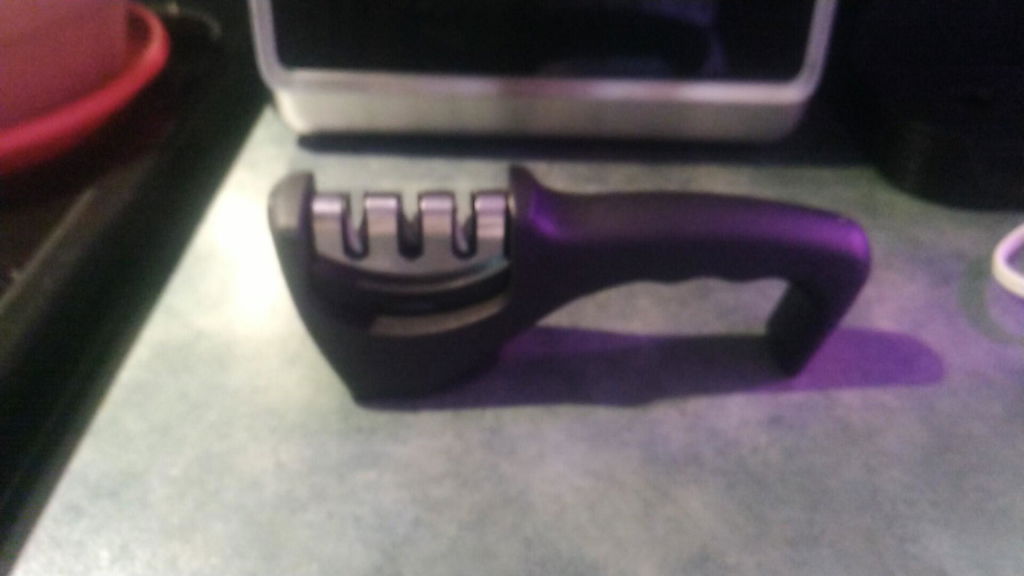
The reliable alternative is a slot sharpener with a preset angle. The principle is simple: you pass the blade through successive slots, each ensuring a step of the work.
- First slot: sharpening, to straighten a damaged edge
- Second slot: honing, to create the sharpness
- Third slot: polishing, to finish the edge
A compact professional sharpener like the one in our range follows this principle in three passes. The angle is fixed by the construction, so the result no longer depends on the regularity of your hand.
Lifespan and Real Cost: What You Pay Over Ten Years
The purchase price says nothing about the real cost. A low-priced classic knife is replaced every two to four years. Over ten years, this represents three purchases, plus blades that never really cut.
A professional knife is bought once. Its price remains affordable with us: €34.99 for an ultra-sharp Japanese knife or a model in forged steel. A professional sharpener starts at €22.99 for the professional 10-second knife sharpener.

The calculation is simple. Three classic knives spread over ten years often cost more than one good knife accompanied by a sharpener. The difference is that the latter saves you time every day.
What we also forget: lost time. A cut that catches adds minutes to every meal. Multiplied over a year, these minutes become hours.
Are Japanese Knives Professional Knives?
Not automatically. The term "Japanese" describes a manufacturing tradition and a blade profile, not a grade. A cheap Japanese knife remains a classic knife with a seductive name.
What distinguishes a real professional Japanese knife comes down to three elements: the hardness of the steel, the sharper sharpening angle than on Western knives, and the finish of the blade.
The tighter angle gives an edge that bites immediately. It requires, in return, harder steel, otherwise the edge dulls in a few uses.
The models in our selection feature a hammered blade and high-quality stainless steel. The hammered texture is not just aesthetic: it limits the adhesion of food and changes the feel of the cut.
How to Choose According to Your Cooking Style
The right choice depends on how much you cook, not your budget. Here’s how to decide based on your situation.
You cook on weekends, a few meals a week. A decent classic knife is enough. Add a sharpener to prevent it from getting dull, and you’ll be equipped for years.
You cook every day. Upgrade to a professional stainless steel knife. It forgives missed maintenance and stays sharp long enough not to slow you down.
You want maximum precision. Carbon steel or a Japanese knife with a hammered blade will give you superior bite. Plan for the maintenance that comes with it.
- To start: a versatile knife and a slot sharpener
- To advance: a forged knife with a three-zone profile
- For the passionate cook: a Japanese knife and a stone for precision sharpening
The real obstacle isn’t choosing between two categories; it’s knowing which one matches how often you actually cook. Most disappointments come from a professional knife bought by someone who cooks twice a month, or a classic knife bought by someone who cooks every day.
At Hell-kitchen-equipment, we built our range around this observation: a good tool and proper maintenance are worth more than a collection. Our Japanese knife at €34.99 combines high-quality stainless steel with a non-slip two-tone wood and resin handle. Our professional sharpeners, from €22.99, restore a clean edge to a tired blade in just a few passes, with no special technique required.
Browse our selection and equip your kitchen with tools that work for you.
Frequently Asked Questions
What is the difference in lifespan between a professional knife and a classic knife?
It all depends on the steel and maintenance. A stamped knife made from low-grade steel becomes dull in a few months and its blade warps. A professional knife made from high-quality stainless steel or forged steel keeps its edge after hundreds of cuts, provided you sharpen it regularly. The difference isn’t an expiration date, but the blade’s ability to regain its edge without losing material.
Are Japanese knives considered professional knives?
Not automatically. What defines a professional knife is the quality of the steel, the hardness of the blade, the balance, and the edge retention. A Japanese knife with a hammered stainless steel blade meets these criteria: it glides through food without crushing it and reduces the stickiness of slices. But a decorative Japanese knife made from soft steel remains a classic knife, regardless of its style.
What are the advantages of forged steel knives compared to stamped knives?
Forging heats and hammers a single piece of steel, which densifies the structure and extends edge retention. A stamped knife is cut from a sheet, making it lighter and cheaper, but its blade becomes dull faster. For intensive daily use, a forged knife requires less frequent sharpening. For occasional use, a good-quality stamped knife is more than enough.
How to sharpen your knives without damaging them?
Use a pre-angled sharpener rather than a handheld stone. Pass the blade through the sharpening slot three to five times, then through the polishing slot once or twice. A professional sharpener with a non-slip base removes just enough material and does not deform the edge. Sharpen as soon as the blade crushes a tomato instead of slicing through it, not when it no longer cuts at all.