Last updated: November 12, 2026
Quick Summary
A thick base stabilizes cooking: it distributes heat evenly, limits hot spots, and retains its temperature when you add cold food. It also resists warping better. The quality of the base matters more than its weight alone.
- A multilayer base of 2.5 to 3 mm with an aluminum core of 1.5 to 2 mm distributes heat well.
- The thermal inertia of the thick base also slows down temperature changes, making it less suitable for delicate cooking.
- A thin base is suitable for quick cooking such as crepes or omelets.
- Place a magnet on the base: if it sticks, the utensil is induction-compatible.
- A very heavy stockpot will tire you out over time: check the empty weight before buying.
Table of Contents
- Why the thick base changes your way of cooking
- The benefits of a thick base in everyday life
- Thick base or thin base: what really changes in the kitchen
- The materials of kitchen utensils and their influence on cooking
- Induction compatibility for casseroles: what to check before buying
- How to choose a quality casserole: the criteria that matter
- Choosing your next thick-based utensil
- Frequently Asked Questions
Why the thick base changes your way of cooking
A thick base is a cooking base whose thickness and construction slow down the transfer of heat to the food. A thick base is a game changer, not just the price.
Here is why this manufacturing detail deserves your attention before any other marketing argument.
Three ideas come back in this guide:
- A thick base does not make cooking faster, it makes it more stable.
- The quality of the base matters more than its weight alone.
- The right choice depends on your recipes and your stove, not on a trend.
We will see how to recognize a good base, what materials compose it and how to match it to your way of cooking.
The benefits of a thick base in everyday life
The benefits of a thick base are measured in everyday life: less food sticking, fewer failures, fewer unnecessary movements. A well-constructed casserole forgives small mistakes.
Heat distribution that limits hot spots
Heat distribution refers to the way the temperature spreads over the entire cooking surface. A thick base diffuses this heat evenly. Result: no burning zone in the center and no lukewarm edge. Your sauces no longer stick in patches. Your vegetables brown evenly at the same time.
Concretely, the thickness of the base plays on two parameters: the total thickness of the base and the thickness of the conductive core (aluminum or copper). A multilayer base of 2.5 to 3 mm total thickness with an aluminum core of 1.5 to 2 mm distributes heat much more evenly than a single 1 mm base. Serious manufacturers often indicate these values in the technical sheets.
Thermal inertia that stabilizes cooking
Thermal inertia is the ability of a utensil to keep its temperature when you add cold food. A thin-based pan drops sharply as soon as you throw meat in it. A thick base absorbs this shock and recovers quickly.
This inertia has a downside: it also slows down temperature changes. If you lower the heat, a very thick base takes longer to cool down.
Resistance to warping and safety
A thick base resists thermal expansion better. When you heat a thin base, the internal stresses of the metal create a bulge or warping.
A criterion that many forget: weight. A very heavy stockpot tires you out over time, especially when it is full.
If you wonder if a durable utensil is really worth its price, consult our analysis on durable kitchen utensils to compare cost and lifespan.
Thick base or thin base: what really changes in the kitchen
A thin base heats up quickly. A thick base heats up more slowly but retains its heat. It is not a question of better or worse, it is a question of use.
A thin base is suitable for a crepe, a quick omelet or an express reheating.
| Criterion | Thick base | Thin base |
|---|---|---|
| Heat distribution | Even, few hot spots | Uneven, burning zones |
| Thermal inertia | High, stable temperature | Low, drops when adding food |
| Responsiveness | Moderate, gradual temperature rise | Immediate |
| Resistance to warping | Good, less stress in the material | Sensitive to thermal expansion |
| Weight | Heavier, grip to check | Light, easy to handle |
| Maintenance | Simple, stainless steel often dishwasher safe | Variable depending on the coating |
The real compromise is between inertia and responsiveness. A thick base gives you stability. A thin base gives you speed.
The materials of kitchen utensils and their influence on cooking
The material decides the thermal conductivity, therefore the way heat circulates. Aluminum conducts quickly and well. Copper conducts even better, but costs more. Stainless steel alone conducts poorly, which is why it is combined with other metals. Cast iron retains heat for a long time.
A good thick-based utensil often combines several layers: an aluminum or copper core between two sheets of stainless steel. This is what we call a multilayer base. To go further, our guide on the benefits of stainless steel details this material layer by layer.
Induction compatibility for casseroles: what to check before buying
Induction compatibility for casseroles rests on a simple point: the base must contain a magnetic metal. Without this, the stove does not detect the utensil and does not heat up. A multilayer stainless steel base with a magnetic layer works.
Before buying, check these points:
- Place a magnet on the base: if it sticks, the utensil is induction-compatible.
- Look for the "induction compatible" mention on the packaging or product sheet.
- Check that the base is flat, without bulging, for a direct contact with the stove.
- Check the diameter compared to your cooking zone.
A poorly constructed thick base can also pose a problem: if it warps at high heat, the contact with the stove is lost. To go deeper, our article on choosing an induction cookware set details the criteria to check.
How to choose a quality casserole: the criteria that matter
Choosing a quality casserole means measuring the base before looking at the rest. The thickness of the base, its construction and its flatness weigh more than the color of the handle.
Review these criteria:
- Measured thickness: a thick multilayer base is felt by weight and seen on the technical sheet. For a pan or casserole, a base of 2.5 to 3 mm total thickness is a good benchmark for everyday use. For a stockpot or marmite, we often find 3 to 4 mm. Below 2 mm, the base is considered thin.
- Construction: look for the number of layers and the nature of the core. A multilayer base generally combines an aluminum (or copper) core between two sheets of stainless steel. The thickness of the conductive core matters more than the total thickness: a 1.5 to 2 mm aluminum core offers good diffusion. A fitted base (welded disc) can work, but check the quality of the weld and the flatness.
- Flatness: a flat base heats evenly, a bulging base does not. Place the utensil on a flat surface (a granite countertop or a glass plate) and press lightly on the edges: if it tips, the base is not flat. You can also pass a metal ruler over the base to spot a bulge.
- Compatibility with your stove: for induction, the base must contain a magnetic metal. Place a magnet on the base: if it sticks, the utensil is induction-compatible. On gas, the flame heats the base directly; a thick base distributes heat better but takes longer to heat up. On ceramic and electric, flatness is crucial for a direct contact. Always check the "induction compatible" mention on the packaging or product sheet.
- Handles: they must remain safe and not heat up. A solid stainless steel handle can become burning hot; prefer a handle with an insulating coating or a bakelite handle if you cook often. Check that the fixation is solid (rivets or welding) and that the handle does not turn.
- Lid: a transparent lid allows monitoring without interrupting the cooking. Check that it fits well and that the handle remains cold.
A criterion that many forget: weight. A very heavy stockpot tires you out over time, especially when it is full. Think about ergonomics and safety, not just performance. For a casserole that you handle often, check the grip and the empty weight before buying.
Practical tests to check quality
In the store or at home, you can do a few simple tests to evaluate a thick base:
- Heating test: heat the casserole on medium heat with a little water. If the water simmers evenly over the entire surface, the distribution is good. If it boils in patches, the base has hot spots.
- Warping test: heat dry (without anything) on medium heat for a few minutes, then let cool. A quality base remains flat; a thin base can warp.
- Weight and balance test: fill the casserole halfway with water and lift it by the handle. It must not tip and the handle must not heat up.
These tests do not replace a detailed technical sheet, but they give a good idea of the construction. If you still hesitate on the format, browse our guide to choose an everyday pan and complete your reflection on thick bases.
Choosing your next thick-based utensil
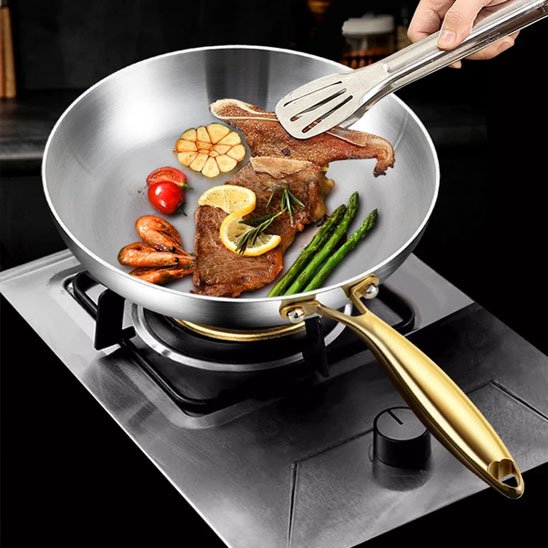
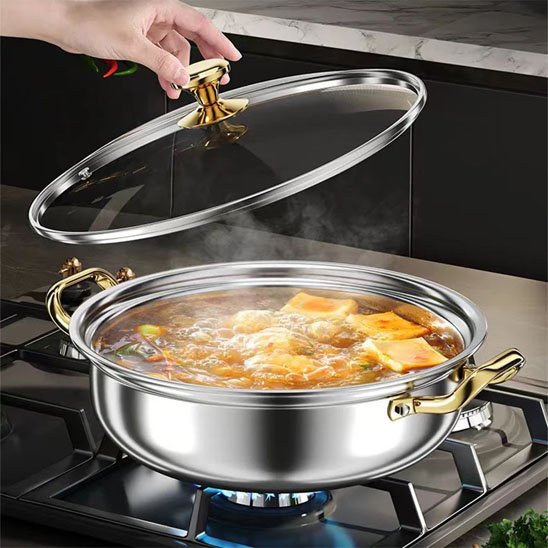
The right thick-based utensil depends on your recipes, your stove and your budget. For regular cooking on induction, discover our thick-based stainless steel casserole, induction compatible and delivered with its lid. For a clean sear and mornings without hiccups, our thick-based stainless steel pan distributes heat evenly and works on induction, gas, ceramic and electric. For slow-cooked dishes, the professional stainless steel stockpot with glass lid allows monitoring the cooking without losing heat. And for large gatherings, the large capacity kitchen stockpot handles soups, broths and pasta without failing.
If you are still unsure about the size, browse our guide to choosing an everyday frying pan and continue your research on thick bases.
Choosing a utensil with a thick base means fewer mistakes and more enjoyment in the kitchen. At Hell-kitchen-equipment, we select utensils designed for performance: even heat distribution, a robust construction, and compatibility with all heat sources.
Frequently Asked Questions
What is a pot's thick base used for?
A thick base distributes heat evenly across the entire cooking surface and helps prevent hot spots. It also provides thermal inertia: the temperature fluctuates less sharply when you add cold ingredients. As a result, food is less likely to stick, simmering remains consistent, and searing is easier to control. On a pot with a thin base, heat concentrates in the center and cooking becomes uneven as soon as the burner gets hot.
Do utensils with thick bases use less energy?
A thick base retains heat and releases it over a longer period. However, it takes longer to heat up initially. The trade-off is between responsiveness and inertia: a more responsive base may be sufficient for quick searing.
How can you identify a high-quality pot with a thick base?
Weigh the utensil: a thick base can be felt in its weight without making the pot impossible to handle. Look at the edge of the base if it is visible; it should show several uniform layers without bubbles or gaps. Check that the base is perfectly flat, as a domed base will wobble on the burner. Finally, check compatibility with your burner, especially induction, and the sturdiness of the handles. A three-layer stainless steel and aluminum base remains the most common benchmark for everyday use.
Is a frying pan with a thick base suitable for all types of cooking?
It is very suitable for searing, long cooking times, simmering, and dishes that can withstand a stable heat. It is less suitable for very fast cooking where you are looking for an immediate response to changes in heat, such as some delicate preparations. For eggs and foods prone to sticking, a non-stick coating combined with a thick base makes everyday cooking easier. The main thing is to adapt the utensil to the recipe rather than expecting the same responsiveness everywhere.