

Table of Contents
- Why Durable Cookware Changes Your Daily Life
- Eco-Friendly Cookware Materials: What Really Matters
- Induction, Gas and Oven Compatibility: The Test to Perform Before Buying
- Stainless Steel Cookware Care: Habits That Extend Its Lifespan
- How to Sharpen Your Kitchen Knives Without Damaging Them
- Recyclability, Second-Hand, and Scratch Resistance: The Blind Spots of Sustainable Choice
- How to Assess the Real Durability of a Utensil in 5 Minutes
- Frequently Asked Questions
Last Updated: September 16, 2026
Why Durable Cookware Changes Your Daily Life
The tips for choosing durable cookware are not a matter of luxury: they are what separates a smooth preparation from a chore. The same mistake is repeated: buy quickly, buy again often, and end up with a drawer of tools that scratch or rust within a year. The tips for choosing durable cookware boil down to one idea: the right material, properly maintained, costs less over ten years than an annual replacement.
The cookware market has become fragmented: entry-level in plastic and aluminum, mid-range in 18/10 stainless steel, high-end in natural cast iron and copper. The concrete result? A well-chosen stainless steel pan withstands years of high-heat cooking where a cheap non-stick coating degrades in a few months. European regulations on food-contact materials govern inert materials and migration thresholds, which explains why some utensils are designed to last and others are not.
Eco-Friendly Cookware Materials: What Really Matters
An eco-friendly utensil does not transfer particles into food, resists corrosion, and is recyclable. Three families dominate.
Inert Materials to Choose
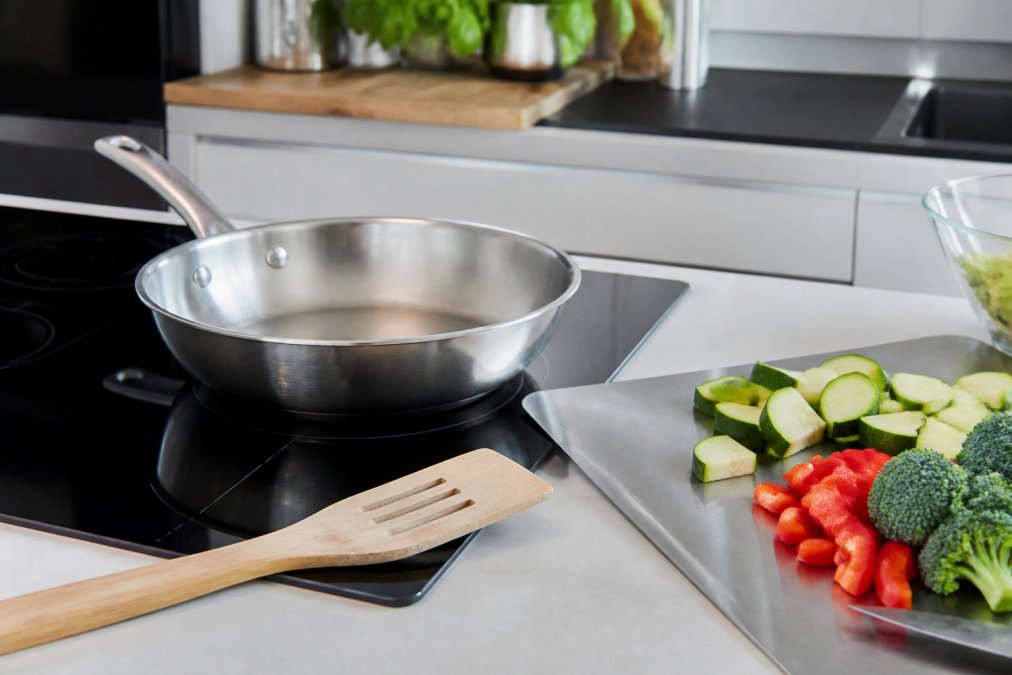
18/10 stainless steel remains the benchmark: inert to acidic foods, resistant to high temperatures, and fully recyclable. Seasoned natural cast iron develops a non-stick surface without PFOA or PTFE. Borosilicate glass and unglazed ceramic complete the list for dishes and molds, with slow conductivity but total thermal inertia.
| Material | Strength | Limitation | Ideal for |
|---|---|---|---|
| 18/10 Stainless Steel | Inert, recyclable, acid-resistant | Sticks if poorly heated | Pans, boards, spatulas |
| Natural Cast Iron | Non-stick after seasoning, very durable | Heavy, specific maintenance | Searing, simmering |
| Borosilicate Glass | No transfer, oven-safe | Brittle under thermal shock | Dishes, molds |
| Unglazed Ceramic | Inert, heavy-metal free | Fragile, heats slowly | Gratins, stews |
Materials to Avoid and Why
BPA-free plastic is still plastic: when heated, it releases additives and scratches, trapping bacteria. Scratched Teflon transfers particles as soon as the layer is compromised. Non-anodized aluminum reacts with acids and leaves a metallic taste; anodizing partially corrects the problem, but the anodization wears out.
Induction, Gas and Oven Compatibility: The Test to Perform Before Buying
Induction compatibility is tested with a magnet on the bottom: if it sticks, the stainless steel or cast iron will heat; if it slides, the utensil is made of aluminum or unencapsulated copper. But it says nothing about real durability over the complete life cycle, from ore extraction to end of life.
Tests to Perform in Store, Heat Source by Heat Source
- Induction: magnet mandatory, ferromagnetic bottom. A bottom of less than 3 mm heats poorly and warps.
- Gas: any material is suitable, but avoid bottoms that are too thin, which burn food. Cast iron and thick stainless steel distribute heat better.
- Oven: metal handle and stainless steel rivets only. An untreated glued plastic or wooden handle does not withstand more than 180 °C.
- Copper: excellent conductivity, but never on induction without a stainless steel encapsulated bottom. Bare copper reacts with acids and oxidizes.
The Blind Spot: Life Cycle Assessment (LCA)
To talk about durability, we must look at three phases: manufacturing, use, and end of life.
The manufacturing of an 18/10 stainless steel pan is energy-intensive: nickel and chrome extraction, melting, rolling. Cast iron weighs even more, its melting requiring higher temperatures. Recycled aluminum or stainless steel greatly reduces this footprint, hence the appeal of second-hand.
The use phase is neglected: a non-stick pan degrades in a few months to a year, multiplying replacements. A well-maintained stainless steel or cast iron pan lasts ten to thirty years. Pro-rated to the year of use, its carbon footprint becomes much lower than that of a cheap utensil replaced regularly.
End of Life: Recyclable or Household Waste?
| Material | End-of-Life Stream | Recyclability |
|---|---|---|
| 18/10 Stainless Steel | Scrap metal (recycling center or metal collector) | High, indefinite remelting without loss of quality |
| Natural Cast Iron | Scrap metal | High, remelting possible |
| Copper | Specialized scrap metal | High, high trade-in value |
| Borosilicate Glass | Glass stream (depending on the center) | Medium to high |
| Unglazed Ceramic | Household waste | Low, not recyclable in its current state |
| Multi-layer Non-stick | Household waste | Very low, difficult metal/coating separation |
A stainless steel, cast iron, or copper utensil is highly recyclable without loss of quality: it can be remelted indefinitely. A multi-layer non-stick coating, however, is difficult to separate: the chemical layer and the metal recycle poorly together and end up as household waste.
The Scratch Resistance Test Before Buying
The scratch resistance test is simple: run your fingernail over the surface. A white mark indicates a soft material.
Stainless Steel Pan | Ultra-Resistant & Long-Lasting →
The Second-Hand Reflex
A used cast iron pan is often better than a low-end new one: the seasoned surface improves and the price drops.
Stainless Steel Cookware Care: Habits That Extend Its Lifespan
The care of stainless steel cookware boils down to three rules: dry immediately, avoid abrasives, and never soak.
How to Sharpen Your Kitchen Knives Without Damaging Them
Sharpening a knife without damaging it relies on a little-known distinction: honing restores the edge, sharpening rebuilds the angle.
Why Sharpening is a Durability Criterion
A poorly sharpened knife forces you to apply more pressure, which deforms the edge and eventually cracks the blade at the spine.
The Three Families of Tools and Their Impact on the Blade
| Tool | Mechanism | Material Removed | Blade Durability |
|---|---|---|---|
| Honing Rod (honing) | Straightens the edge through light abrasion | Very little | Excellent if used between sharpenings |
| Whetstone (sharpening) | Controlled abrasion at a constant angle | Moderate, controlled | Very good if the angle is maintained |
| Electric Pull-Through Sharpener | Heavy and repeated abrasion | High | Poor: shortens the lifespan |
| Fixed-Angle Sharpener | Abrasion guided by a support | Low to moderate | Very good, reproducible |
The method that preserves the blade
When to replace rather than resharpen
A knife can be resharpened as long as the edge can be rebuilt.
Recyclability, second-hand, and scratch resistance: the blind spots of sustainable choice
Three criteria determine the real durability of a utensil, rarely addressed together: end-of-life recyclability, scratch resistance, and second-hand use.
How to assess the real durability of a utensil in 5 minutes
The 5-point method:
Frequently Asked Questions
Which materials should be prioritized for durable kitchen utensils?
18/10 stainless steel, natural cast iron, borosilicate glass, and lead-free ceramic are among the most resistant materials. They do not release particles into food and withstand high temperatures without deforming. Hardwood remains useful for spatulas, as it scratches coatings less. Conversely, low-end plastic and non-anodized aluminum wear out quickly and can transfer residues. Always check the composition indicated by the manufacturer before buying.
How to maintain stainless steel utensils so they last longer?
Wash stainless steel in hot water with a mild dish soap, then dry immediately with a cloth to prevent water spots. For stubborn stains, use diluted white vinegar or baking soda, never abrasive steel wool. Avoid chlorinated detergents that attack the passive layer and promote corrosion. Regular maintenance of your stainless steel kitchen utensils preserves their shine and thermal conductivity for years, even with daily use.
Why choose stainless steel kitchen utensils instead of Teflon?
Stainless steel contains neither PFOA nor PTFE, two substances classified as potential endocrine disruptors when non-stick coatings wear out. It resists scratches, is oven-safe, and is dishwasher-safe without losing its properties. A scratched non-stick pan releases particles into food and must be replaced every two or three years. Stainless steel, on the other hand, lasts for decades. The compromise: you must learn to control the cooking temperature to prevent food from sticking.
How to know if a kitchen utensil is really of good quality?
Weigh it: a durable utensil is heavier than a low-end model of the same size. Look at the finish of the welds, the thickness of the metal, and the mention of the steel grade (18/10 for stainless steel). Check induction compatibility by holding a magnet to the bottom. Consult the life cycle analysis when available, and prefer products that are recyclable at the end of their life. A quality kitchen utensil is designed to be repaired or recycled, not thrown away after one year.
