Table of Contents
- Why the question "professional knife sharpener, really useful?" deserves an honest answer
- Difference between sharpening and honing: the vocabulary that changes everything
- How to know if a knife is dull: the signs that do not lie
- The different types of sharpeners: manual, electric, or sharpening stone
- Advantages and limitations of a mechanical sharpener: what salespeople do not tell you
- Best professional kitchen knife sharpener: comparison and selection criteria
- Knife sharpening frequency: how often to maintain your blades
- Common mistakes, metal loss, and steel compatibility: what really damages a blade
- Maintenance, longevity, and when to call a professional sharpener
- Conclusion: is a professional sharpener useful for you?
- Frequently Asked Questions
Last updated: September 18, 2026
Why the question "professional sharpener, really useful?" deserves an honest answer
Is a professional knife sharpener really useful? The short answer: yes, provided you understand what it really does and what it will never do. A professional sharpener is a tool that restores a functional cutting edge to a dull blade by controlling the cutting angle, without requiring mastery of a sharpening stone. At Hell-kitchen-equipment, we enable both passionate amateurs and demanding cooks to cook simply and with pleasure, improving their efficiency with tools designed for performance.

The misunderstanding often comes from marketing. Many manufacturers promise "blades like new" without specifying that a sharpener removes material with every pass. A poorly used sharpener damages more than it repairs. A well-chosen sharpener, used at the right pace, can extend the life of a knife.
This guide answers a specific question: in what cases does a professional sharpener really change your daily life in the kitchen, and in what cases is it useless. We will explain the risks to the blade, and give you a selection method based on the type of steel.
Difference between sharpening and honing: the vocabulary that changes everything
Sharpening means restoring a cutting edge to a blade that has lost it, by working the cutting edge at a precise angle. Honing goes further: we reshape the complete geometry of the bevel, the beveled part of the blade, by removing material in a controlled manner. Confusing the two leads directly to bad purchases.
The difference lies in intensity and frequency:
- Honing: a regular, light maintenance gesture that realigns the existing edge. A honing rod or a quick-pass sharpener is sufficient.
- Sharpening: a heavy operation, performed every six to twelve months depending on use. It requires a more aggressive abrasive, stone or grinder, and removes material.
- Regrinding: an intermediate step that straightens a very damaged blade before finishing.
This distinction explains why a "3-in-1" device can be practical while remaining limited. It handles routine honing, rarely the complete sharpening of a quality blade. To go further on the principles of cutting, the technical sheet on cutting angles and blade maintenance remains a useful reference.
How to know if a knife is dull: the signs that do not lie
The most reliable test consists of one action: cut a ripe tomato without pressing. If the skin tears, if the flesh is crushed, the blade is dull. A sharp knife slices the skin on contact, without pressure.
Other signs do not lie:
- The blade slides over the chicken skin instead of slicing it.
- You have to saw the bread instead of cutting it in one motion.
- Herbs are crushed and turn black instead of being finely chopped.
- You force, your hand gets tired, and the risk of slipping increases.
Micro-serration also plays a role. On a bread knife or paring knife, the blade has small teeth that bite into the cutting surface. When these teeth wear out, the knife "bites" less. A quick-pass sharpener maintains these teeth; a flat stone flattens them if the angle is poorly held.
The different types of sharpeners: manual, electric, or sharpening stone
The choice depends less on the budget than on your relationship with the technical gesture. Three families exist, and each has a clear user profile.
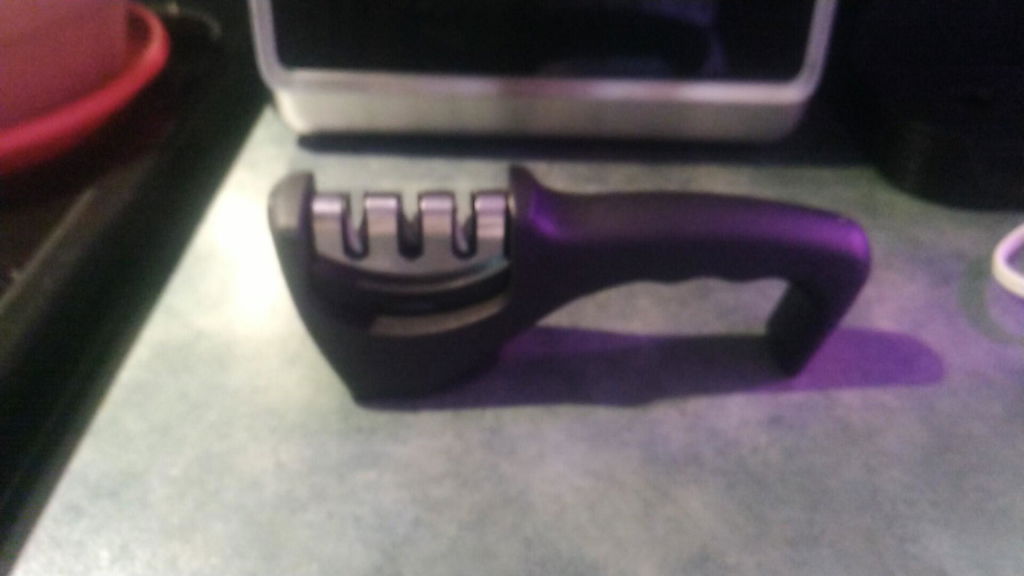
The manual pass sharpener: you pull the blade through pre-set slots. The cutting angle is fixed, the result is reproducible. It is the most accessible system for those who do not want to learn how to hold a stone.
The electric sharpener: a motor drives a grinder or abrasive disc. Fast, but the removal of material is harder to control. Reserved for everyday use blades, not for valuable knives.
The sharpening stone: the reference gesture. It offers total control of the angle, grain, and finish, but requires practice. A poorly held stone damages a blade faster than any device.
| Type | Time per blade | Angle control | Ideal for |
|---|---|---|---|
| Manual pass | 10 to 30 seconds | Pre-set, constant | Daily household use |
| Electric | 20 to 60 seconds | Medium, depends on guidance | Large series of simple blades |
| Sharpening stone | 5 to 15 minutes | Total | Demanding cooks, fine blades |
The honing rod, often placed in the same category, replaces neither one nor the other. It straightens the edge between two sharpenings, it does not create a cutting edge.
Advantages and limitations of a mechanical sharpener: what salespeople do not tell you

A mechanical sharpener excels in one area: consistency. The angle is locked by the design of the device, which can eliminate human error. For a cook who has neither the time nor the desire to learn the gesture, this is a real advantage.
Its limitations lie in three elements rarely highlighted.
First, the abrasive. A carbide sharpener removes a lot of metal with each pass. Practical for saving a dead blade, destructive in daily use. A diamond abrasive is gentler and more durable.
Next, steel compatibility. A sharpener designed for standard stainless steel is not well suited to a ceramic blade, which requires a diamond abrasive, or to a very hard steel, which requires finer angle control.
Finally, metal loss. Each sharpening removes material. A device that is too aggressive used every week wears out a blade in a few months.
Best professional kitchen knife sharpener: comparison and selection criteria
The best professional knife sharpener for the kitchen is the one whose sharpening system matches your blades and your frequency of use.
The three-question selection method
Before looking at a single model, answer these three questions. They determine 90% of the right choice.
1. What is the steel of my blades? If you have a Japanese knife, Damascus, or powdered steel, you need diamond and strict angle guidance. If you have common stainless steel kitchen knives, a ceramic slot sharpener is sufficient. If you have ceramic, explicitly check compatibility.
2. How often will I sharpen? Daily use requires a gentle abrasive (fine diamond, ceramic) so as not to wear out the blade. Occasional use tolerates a more aggressive abrasive, used rarely.
3. What is the value of my knives? On a €15 blade, an aggressive carbide sharpener is acceptable. On a €150 blade or more, metal loss becomes a real cost. Invest in a guided system, even if you have to pay the price.
The criteria that really matter
- Abrasive type: diamond for hard blades and ceramic, ceramic for routine maintenance, carbide only for very damaged and low-value blades.
- Angle guidance: a guided system guarantees a constant angle. It is the number one factor in the quality of the result and the preservation of the blade.
- Abrasive working width: the wider the abrasive works, the more metal it removes. A good maintenance sharpener works narrowly, on the edge only.
- Stability: a non-slip base prevents the device from slipping during the gesture, which protects your fingers and your worktop.
- Number of steps: a two or three-step system (coarse sharpening, sharpening, polishing) covers all cases. Beyond that, it is often marketing.
How to evaluate a sharpener before buying it
Three simple checks, doable in store or upon receipt:
- The paper test. Pass a test blade before and after. If the edge cleanly cuts the vertically held sheet, the sharpener is doing its job. If it tears or catches, the angle or abrasive is unsuitable.
- The ripe tomato test. Cut without pressing. The skin must give way on contact. It is the test closest to real use in the kitchen.
- The bevel height test. Measure the shiny band before and after ten passes. If it widens significantly, the sharpener eats too much steel for regular use.
These three tests, applied to any model, prevent you from making an impulsive purchase and regret.
Knife sharpener | Professional 10 →
Our selection
Our recommendation for the majority of households is the Professional 10-Second Knife Sharpener at €22.99. Its two-stage sharpening system first restores the cutting edge then polishes the edge, and its non-slip base keeps the device stable on marble, wood, or laminate. It folds and stores in any drawer, which makes it usable everywhere.
For those who want even more marked guidance, the Professional Knife Sharpener at €25.99 offers a four-stage numbered system: sharpening, honing, polishing, straightening. Each slot guides the blade to the intended angle, which limits gesture errors.
| Model | Price | Steps | Key Feature |
|---|---|---|---|
| Professional Knife Sharpener 10 Seconds | €22.99 | 2 | Compact, foldable, non-slip base |
| Professional Knife Sharpener | €25.99 | 4 | Numbered guides, very consistent results |
| Professional Knife Sharpener (3 Steps) | €25.99 | 3 | Gradual, suitable for very dull blades |
Knife sharpening frequency: how often to maintain your blades
The frequency of knife sharpening depends on three variables: how often you use it, the type of steel, and how you maintain the blade between sharpenings. There is no universal schedule, but there are reliable guidelines.
For a chef's knife used every day:
- Honing with a steel: two or three passes before each cutting session.
- Light sharpening: every two to four weeks.
- Full sharpening: once or twice a year, depending on the wear observed.
A knife used occasionally on weekends only needs sharpening every two to three months. A blade made of very hard steel retains its edge longer but requires more work once it has lost it. A standard stainless steel blade is easier to maintain but dulls faster.
The best approach: sharpen as soon as the tomato test fails, not according to a fixed schedule. Sharpening too frequently wears out the blade unnecessarily.
Common mistakes, metal loss, and steel compatibility: what really damages a blade
Three mistakes occur repeatedly, and each destroys a blade in its own way. But before listing them, it is important to understand a mechanism that almost no guide explains: why some sharpeners literally "eat" the steel of your knives.
Why some sharpeners remove too much metal: the real mechanism
A sharpener does not remove metal "out of spite." It removes it because its abrasive creates scratches that tear away material. Three factors determine the amount of steel lost with each pass:
- The hardness of the abrasive compared to the steel. Tungsten carbide, used in cheap slot sharpeners, is significantly harder than most kitchen steels. It does not just sharpen: it digs. Diamond, which is even harder but applied in fine, controlled grains, removes less material per pass while working faster on hard steels.
- The pressure applied by the user. A quick-pass sharpener encourages applying strong pressure. However, the amount of metal removed increases non-linearly with pressure: applying twice as much pressure does not remove twice as much steel, but far more. This is the leading cause of blades being "eaten" in just a few months.
- The geometry of the slot. A V-shaped slot that clamps the blade across its entire bevel removes material over a wide band. A slot that only works on the edge, over a few tenths of a millimeter, preserves the original geometry.
Steel compatibility: which sharpener for which type of blade
Choosing a sharpener unsuitable for your steel can lead to disappointment after purchase.
Softer steels (standard stainless steel such as X50CrMoV15, common German kitchen knife steels). Their hardness is generally around 54 to 56 HRC. They dull quickly but are easy to resharpen. A manual ceramic or fine diamond slot sharpener is more than sufficient. Avoid regular use of carbide: it wears down a soft blade even faster than a hard blade, as the abrasive bites deeply into the less resistant metal.
Hard steels (VG10, Japanese steels such as AUS-10, powder steels). Their hardness often exceeds 60 HRC. They retain their edge remarkably well but resist conventional abrasives. A standard ceramic sharpener will patina without biting. Diamond is required, with strict angle guidance: these blades do not tolerate irregular angles well and will chip instead of dulling cleanly.
Damascus. Beware of the trap: Damascus is a surface aesthetic, not a type of steel. What matters is the core of the blade, which is often a hard steel (VG10, powder steel). A Damascus knife should therefore be treated like a hard steel knife, with a diamond abrasive and a consistent angle. The Damascus layer itself should never be worked: it is decorative and thin.
Ceramic. It should only be worked with diamond, at a closed angle, and remains brittle. A classic slot sharpener will break it. If you own a ceramic knife, explicitly check that the device states ceramic compatibility.
High-carbon steel (non-stainless). It takes a remarkable edge but oxidizes quickly. It tolerates diamond well, provided you dry the blade immediately after sharpening and apply a light coating of oil.
The testing protocol to measure metal loss yourself
Two simple methods can help assess steel wear:
- The bevel height test. Before sharpening, measure the height of the shiny band on the blade with a caliper (or estimate it with a ruler). After ten passes, measure again. If the band has doubled in width, your sharpener is working too wide and wearing out the blade prematurely.
- The paper test. After sharpening, cut an A4 sheet of paper while holding it vertically. A proper edge will slice through it cleanly, without snagging. An over-sharpened but fragile edge will tear it or collapse on the second pass. This test also reveals whether the angle is too closed for the steel being used.
These two tests, repeated over time, can give you an idea of your device's abrasiveness.
The three mistakes that really damage a blade
Inconsistent angle. The leading cause of premature wear. Each pass at a different angle creates an irregular micro-serration and fatigues the edge. A guided system eliminates this problem; freehand use makes it worse.
Unsuitable abrasive. An overly aggressive abrasive removes material unnecessarily.
Maintenance, longevity, and when to call in a professional sharpener
A well-maintained knife can last a long time. A poorly sharpened knife can deteriorate more quickly.
The actions that prolong a blade's life:
- Wash by hand, dry immediately, and store on a support or in a case.
- Never cut on glass, marble, or ceramic: these surfaces dull blades instantly.
- Straighten the edge with a steel before each use rather than waiting until it is dull.
- Sharpen at regular intervals, without overdoing it.
Conclusion: is a professional sharpener right for you?
A professional sharpener is useful as soon as you cook regularly and own at least one good knife. It does not replace technique, but it eliminates the obstacle that leads most people to buy new blades instead of maintaining them. The risk is choosing one that is too aggressive and ill-suited to the steel of your blades.
Frequently Asked Questions
Can a professional sharpener damage my blades?
A sharpener that is misused or unsuitable for your steel can remove too much metal and create a micro-serration. Pre-set angle models reduce this risk by maintaining a consistent cutting angle. Always check compatibility with your blade type: standard stainless steel tolerates mechanical sharpening well, while a ceramic blade or very hard steel requires a stone or a guided system.
What is the difference between sharpening and honing a knife?
Honing consists of straightening the blade's edge without removing material, often with a honing steel. Sharpening removes a thin layer of metal to recreate a new edge, using an abrasive such as a stone or a mechanical sharpener. Honing maintains the edge; sharpening restores it. Confusing the two wears out the blade prematurely or leaves a knife dull.
How often should you use a knife sharpener?
For daily household use, light honing with a honing steel before each cutting session is sufficient. Full sharpening is necessary every two to three months, depending on wear. In professional kitchens, the frequency increases: some chefs sharpen every week. Monitor the blade's edge: as soon as it crushes a tomato instead of slicing it, it is time to sharpen.
What are the advantages of a professional sharpener compared to a sharpening stone?
A professional sharpener with a pre-set angle requires less technical skill than a stone. You get consistent results without having to master the cutting angle. A stone offers more control and better preserves the original bevel, but requires practice. For an enthusiastic amateur who wants a razor-sharp edge quickly, a mechanical sharpener remains easier to use on a daily basis.
Can you achieve a razor-sharp edge with a manual sharpener?
Yes, provided you follow the steps: rough sharpening, sharpening, and then polishing. A good manual sharpener with multiple slots, such as the Professional 10-Second Knife Sharpener at €22.99, combines diamond abrasive and polishing for results comparable to professional sharpening. The number of passes should be adapted to the condition of the blade, without forcing it to avoid creating a burr.