Table of Contents
- Buying a professional knife sharpener: what really changes your blades
- Professional manual sharpener: the format that suits most kitchens
- Electric knife sharpener: for whom, at what price, and what limits
- How to sharpen a kitchen knife: the 3-pass method
- Blade compatibility: steel, ceramic, serrated and special geometries
- Knife sharpening price: what blade maintenance costs over twelve months
- Safety, abrasive maintenance and durability: what determines the lifespan
- Which knife sharpener to choose according to your profile and volume of use
- Frequently Asked Questions
Last updated: October 16, 2026
Buying a professional knife sharpener: what really changes your blades
A dull knife requires up to three times more force to cut through food, and that's often when accidents happen. Buying a professional knife sharpener is therefore not just another gadget in the drawer: it's the tool that determines whether your food preparation remains a pleasure or becomes a chore.
The truth is that most French kitchen knives are not worn out. They are poorly maintained. A tempered steel blade retains its structure for decades; what disappears is the edge, that fine ridge that makes all the difference when it comes into contact with a tomato.
This guide compares the types of sharpeners and their compatibility with each blade geometry. You will know exactly what to choose according to your use.
Professional manual sharpener: the format that suits most kitchens
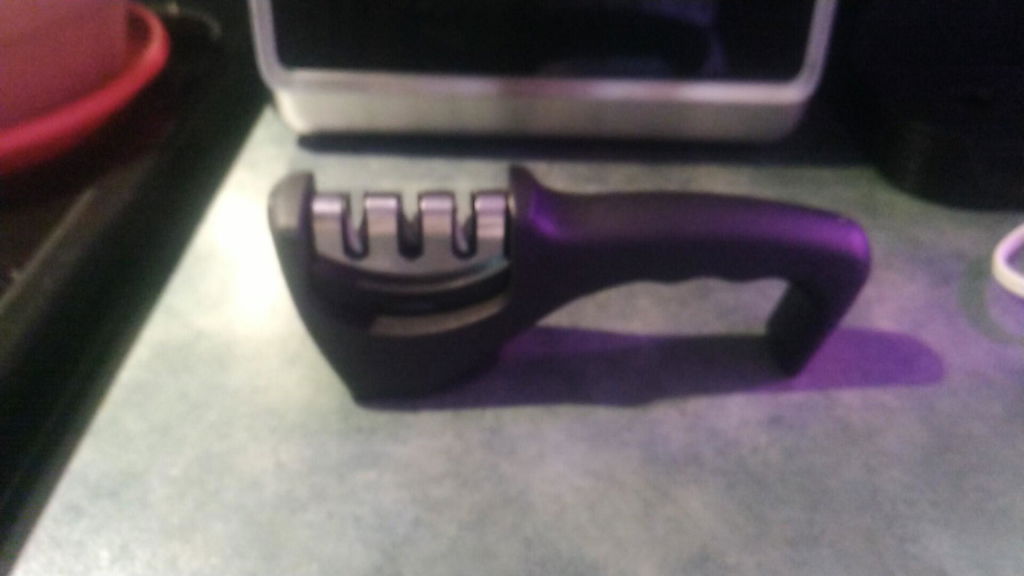
The professional manual sharpener is the most versatile format for a demanding home kitchen. It requires neither an electrical outlet nor any special technique, and fits in a standard drawer.
The principle is simple: one or more slots equipped with an abrasive (carbide, ceramic or diamond) into which you pass the blade at a fixed angle. The angle is preset by the manufacturer, often between 15 and 20 degrees depending on the models. That is precisely its advantage: you no longer have to maintain the angle by hand, the most common mistake among beginners.
Our manual models cover two approaches:
- Multi-stage systems (2 to 4 stages): the first stage straightens the damaged blade, the second creates the cutting edge, the third polishes the edge. Three to five passes per stage are sufficient.
- Stone and roller systems: a rectangular abrasive surface for very dull blades, complemented by a cylindrical roller that refines the edge. Closer to the logic of traditional sharpening.
The honest limit of this format: on a Japanese knife blade with a very acute angle (10-15 degrees), a preset slot system can remove too much material.
Electric knife sharpener: for whom, at what price, and what limits
An electric knife sharpener is suitable for households that own many blades and want a quick result without any technical gesture. Yet it remains the most misused format, because it is believed to be universal.
The operation is mechanical: rotating grinding wheels driven by a motor reproduce the sharpening angle. You only have to guide the blade. The time saved is real when you need to treat six knives in a row.
The limits, however, are structural:
- High material removal: the abrasion speed wears the blade faster than a controlled manual sharpening.
- Heat: on entry-level models, friction heats the edge and can temper the steel.
- Bulkiness: it requires an outlet, space on the countertop, and dedicated storage.
- Thin and ceramic blades: rarely compatible, unless explicitly stated by the manufacturer.
For a kitchen that runs with two or three straight steel knives, an electric one is often oversized. For intensive use with a complete set, it holds its own.
How to sharpen a kitchen knife: the 3-pass method
How to sharpen a kitchen knife boils down to three well-executed passes on a preset slot sharpener. The regularity of the gesture matters more than the force applied.
Here is the method we recommend, applicable to the majority of our models:
Knife sharpener | Professional 10 seconds →
- Place the sharpener on a stable surface. The non-slip base must adhere completely. On a damp surface, wipe it first.
- First pass, coarse stage. Pull the blade towards you, from the heel to the tip, keeping the edge parallel to the slot. Repeat 3 to 5 times.
- Second pass, intermediate stage. Same gesture, 2 to 3 times, to refine the blade edge.
- Third pass, polishing stage. 2 light passes to remove the burr and obtain a lasting sharpness.
- Test on a tomato. If the blade slides without pressing, it's done. If it still crushes, do a full cycle again.
Expected result: a regular edge along the entire length of the blade, without a dead zone near the heel.
On a very damaged blade, allow two cycles. Beyond that, you remove too much steel for nothing.
Blade compatibility: steel, ceramic, serrated and special geometries
Not all sharpeners are suitable for all blades. This is the point that most guides gloss over, and yet it is the one that damages the most knives.
| Blade type | Slot sharpener | Roller / stone sharpener | Note |
|---|---|---|---|
| European steel knife (20° angle) | Suitable | Suitable | The simplest case |
| Japanese knife (10-15° angle) | Risky | Recommended | The preset removes too much material |
| Ceramic knife | Not compatible | Not compatible | Requires a specific diamond abrasive |
| Serrated blade | Compatible on certain models | Not suitable | Smooth side only, never the teeth |
| Narrow blade (office, fillet) | Suitable with caution | Suitable | Keep the edge flat |
| Kitchen scissors | Compatible on certain models | Not suitable | Check the manufacturer's mention |
Two rules to remember. First, a narrow blade requires more control: it easily tips into the slot and the edge rounds. Next, ceramic blade compatibility is almost always excluded, because ceramic is harder than steel and wears out the abrasive instead of allowing itself to be sharpened.
For serrated knives, we only sharpen the smooth side. Passing the teeth through an abrasive breaks them, and a bread knife with broken teeth cannot be repaired.
Knife sharpening price: what blade maintenance costs over twelve months
The knife sharpening price is compared over twelve months, not at purchase. A sharpener at €13.99 bought once costs less than an annual visit to a professional, from the second year.
Here is the calculation for a household equipped with four kitchen knives, with two sharpenings per year and per blade.
| Option | Initial cost | Recurring annual cost | Over 3 years |
|---|---|---|---|
| Manual slot sharpener | €13.99 | €0 | €13.99 |
| Roller and stone sharpener | €27.99 | €0 | €27.99 |
| Professional sharpening | €0 | €40 to €80 | €120 to €240 |
The reasoning is simple: professional sharpening generally costs between €5 and €10 per blade, and a well-used blade requires two to four passes per year.
This does not make the professional useless. For a valuable Japanese blade, a collector's knife or a special geometry, visiting a craftsman remains the right choice.
Safety, abrasive maintenance and durability: what determines the lifespan
The safety of use and the lifespan of your sharpener depend on three habits, not the price paid.
First, stability. A non-slip base that does not adhere well is the leading cause of slipping. On a marble or granite surface, check that the base is perfectly clean before each use.
Next, abrasive maintenance. A diamond or ceramic abrasive is cleaned with warm soapy water, then dried completely before storage.
Finally, replacement. An abrasive wears out. When you notice that it takes twice as many passes as before to obtain the same sharpness, it is time to change the tool or the abrasive surface.
- Clean the slots after each sharpening session
- Never immerse an electric sharpener in water
- Store the tool away from moisture to prevent oxidation of the metal parts
- Check the condition of the non-slip base every six months
On the safety side, always keep your fingers away from the slot and never test the sharpness with your thumb. Paper, or a tomato, does the same job without risk.
Knife sharpener | Professional 10 seconds →
Which knife sharpener to choose according to your profile and volume of use
The right choice depends on three variables: the number of knives, the frequency of use and the type of blade. Here is how we decide.
Occasional use, two or three steel knives. A manual slot sharpener is more than enough. Our Professional 10-Second Knife Sharpener at €13.99 does the job: two passes over the diamond abrasive, and the blade is sharp again.

Regular use, four to six different knives. A three- or four-stage system becomes more convenient, as it handles both slightly worn blades and very dull knives. Our Professional Multi-Stage Knife Sharpener at €13.99 uses a suction cup, eliminating the risk of slipping on a smooth surface.
Mixed blades, including a bread knife and scissors. In this case, you need a versatile model that accommodates several blade geometries. Our Professional Knife Sharpener at €13.99 handles chef and utility knives, with a non-slip base.

Intensive use or high-end blades. Our Professional Knife Sharpener at €27.99 combines a rectangular stone and a cylindrical roller.

A quick word on the difference between sharpening and honing, as the two terms are often confused. Sharpening straightens and recreates the edge; honing maintains it between sharpenings.
And if you're still unsure: start with a manual one.
A knife that crushes instead of slicing costs you time, precision, and safety with every meal.
Frequently Asked Questions
What is best for sharpening a knife?
It all depends on how often you use your knives and your comfort level with the technique. A professional manual slot sharpener with preset angles is suitable for most kitchens: the angle is fixed, the motion is limited to three to five passes, and the results remain consistent. A roller or stone sharpener requires more practice but refines the edge further. An electric sharpener removes more material and is best suited for severely damaged blades. For weekly use, a manual one is more than enough.
What is the difference between sharpening and honing a knife?
Sharpening involves removing material to recreate a blade edge with a coarse abrasive. Honing, or edge alignment, realigns the existing edge without removing metal, using a polishing tool or sharpening steel. In practice: you sharpen two to four times a year, and hone in between, every one to two weeks. Confusing the two wears out the blade prematurely, as you remove metal where a simple realignment would have sufficed.
How much does it cost to have a knife sharpened?
Having a professional sharpen a knife generally costs between €5 and €10 per blade, depending on the knife's geometry and condition. For four knives sharpened twice a year, the annual cost reaches €40 to €80. For comparison, a manual sharpener from our range costs €13.99 as a one-time purchase, and a roller model costs €27.99.
Is a professional sharpener suitable for all types of knives?
No, and that is the point to check before buying. Slot sharpeners with preset angles are suitable for straight steel blades, including chef and utility knives. Serrated knives require a specific slot, otherwise the teeth become rounded. Ceramic should be sharpened with a diamond abrasive, never with an overly aggressive carbide tool. Finally, a knife with a very fine blade or Japanese geometry prefers a sharper angle than a standard model.
How often should a kitchen knife be sharpened?
For a family kitchen, a full sharpening every two to three months is enough, with more regular edge alignment. Intensive use, several hours of cutting per day, brings the frequency down to once a month, or even every two weeks. The sign is simple: when you have to press down on a tomato to slice it, or when the blade slips on the skin of a chicken, it is time. Waiting too long forces you to remove more metal.