Table of Contents
- Why onions make you cry (and what really makes a difference)
- Technique 1: Chill the onion before slicing it
- Technique 2: Use a perfectly sharp knife
- Technique 3: Wet the blade and rinse the onion under cold water
- Technique 4: Work with airflow and an extractor hood
- Technique 5: Chop onions without tears using a mandoline or chopper
- How to properly sharpen your kitchen knife for clean cuts
- Tips for chopping vegetables quickly (and without crying)
- Common mistakes that make you cry for longer
- Which technique should you choose for your kitchen?
- Frequently Asked Questions
Last updated: September 18, 2026
Why onions make you cry (and what really makes a difference)
Cutting onions without crying remains one of the most universal challenges in the kitchen. According to PubChem's safety data sheet for syn-propanethial-S-oxide, this volatile compound forms within seconds as soon as the blade breaks the onion's cells. Tears are not inevitable. They depend on three specific factors, and once you understand them, you can cut onions while keeping your eyes dry.
The sulfur compound that triggers it all
Onions store harmless sulfur compounds in their cells. When you cut one, you release an enzyme that transforms these compounds into sulfenic acid. This acid then rearranges into syn-propanethial-S-oxide, a natural lachrymatory gas. The gas rises toward your eyes, mixes with the moisture on your cornea, and forms a tiny amount of sulfuric acid. Your nerves react immediately: your tear glands produce tears to dilute the irritation. It's a protective mechanism, not a curse.
The three factors that determine how much you cry
Three variables control how much gas reaches your eyes. First, the number of cells broken: the cleaner your cuts, the fewer compounds you release. Next, temperature: cold slows the enzymes responsible for the reaction. Finally, the distance and airflow between the onion and your face. A dull knife that crushes the onion, a warm room, and a poorly ventilated work surface are the perfect recipe for tears. Change any one of these factors and eye irritation drops noticeably.
Technique 1: Chill the onion before slicing it
Refrigerating the onion for 30 minutes before slicing it significantly reduces tears. The cold slows the activity of the enzymes that produce the irritating gas. For a more noticeable effect, 15 minutes in the freezer is enough: the onion firms up slightly, which also makes it easier to cut cleanly. Avoid freezing it solid, or its texture will become mealy when cooked. This is the easiest method to adopt because it requires no special equipment. One honest caveat: a very cold onion can sometimes slip on the cutting board. Dry it quickly before you start.
Technique 2: Use a perfectly sharp knife
A sharp knife is by far the most effective solution. A sharp blade slices through the cells instead of crushing them, releasing far fewer sulfur compounds into the air. This is where the right equipment really makes a difference. A Japanese Knife | Ultra-Sharp with a hammered blade also reduces food sticking: your slices no longer cling to the steel and fall straight into the dish. The two-tone wood and resin handle stays stable even with wet hands, which matters when you're slicing quickly. At €34.99, it's the investment that will make the biggest difference to your everyday chopping.


Technique 3: Wet the blade and rinse the onion under cold water
Rinsing a peeled onion under cold water before cutting it removes some of the sulfur compounds already released on the surface. A complementary trick is to wet the knife blade: syn-propanethial-S-oxide is soluble in water, so some of the gas dissolves in the thin film of liquid instead of escaping toward your eyes. The technique is simple, but you need to repeat it. Rinse the blade every two or three cuts, because the water film evaporates quickly and stops being effective after just a few seconds.
Why this technique only works halfway
Water acts as a chemical trap, not a shield. It captures the gas when it comes into contact with the blade, but it does nothing to block it between the onion and your eyes. As soon as you lift your head or breathe, the gas already in the air continues on its way. That's why this technique works well alongside chilling or airflow, but disappoints when used on its own. One point most guides overlook: never leave the onion to soak. It will lose flavor, absorb water, and become soft when cooked.
Adapt the technique to the onion variety
Not all onions release the same amount of gas. Red onions, which are richer in sulfur compounds, cause more intense and faster-onset tears: wetting the blade is almost never enough for these, so combine it with chilling. Yellow onions, the most common variety in cooking, fall somewhere in between: a wet blade reduces irritation by about a third, which is helpful but not enough on its own. White onions and sweet onions (such as Roscoff or Cévennes) are the mildest: their lower sulfur content means a simple rinse under cold water is often enough to prevent tears. Remember the rule: the more colorful and pungent an onion is when raw, the more techniques you should combine.
Technique 4: Work with airflow and an extractor hood
Turning on the extractor hood above your work surface carries the gas away before it reaches your face. This is the most underrated technique, and probably the most effective after using a sharp knife. Syn-propanethial-S-oxide is volatile: it rises and disperses into the surrounding air. A steady airflow diverts it from your eyes before it has time to dissolve in your tear film. The principle is purely physical: you create a current that carries the gas elsewhere.
Airflow direction and speed: what really makes a difference
Not all airflow is created equal. A properly sized extractor hood moves several hundred cubic meters of air per hour and creates upward suction above the cutting area: this is ideal, because the gas rises naturally and gets pulled away. If you don't have an extractor hood, open a window and stand to one side of it, creating a cross-breeze that sweeps across the cutting board. A fan placed behind you and pointed outside works too, but take care: a fan pointed the wrong way, blowing toward you, does exactly the opposite and sends the gas straight into your face. The rule is simple: the air should flow away from the onion, never toward you. Passive ventilation—a cracked window without any real airflow—isn't enough. You need noticeable air movement.
The right order of operations
Ventilation works better if you turn it on before you start, not while you're cutting. Turn on the extractor hood or open the window two to three minutes in advance so the airflow is established. Then cut your onions first, before the other vegetables: the gas disperses while you prepare the rest, and you avoid breathing in sulfur compounds for twenty minutes straight. If you need to chop several onions, do them all at once rather than in separate sessions: every new cut starts gas production again in a room that is already saturated.
Technique 5: Chop onions without tears using a mandoline or chopper
A closed chopper physically prevents the gas from escaping toward your eyes. The Mini Manual Chopper | QuickChop works on this principle: you pull the cord, the stainless steel blades spin inside a closed transparent bowl, and the onion is chopped without you having to lean over it. At €23.99, it's the fastest way to chop several onions in a row. The markings on the bowl let you control how finely they're chopped. For even slices rather than chopped onion, a Kitchen Mandoline | Quick Precision at €23.99 delivers clean, uniform cuts with a stainless steel blade and adjustable thickness. The safety pusher keeps your fingers away from the blade.
Japanese Knife | Ultra-Sharp →


| Technique | Preparation time | Equipment required | Effectiveness against tears |
|---|---|---|---|
| Chilling | 15–30 min | Refrigerator | Good |
| Sharp knife | Immediate | Sharpener, knife | Very good |
| Wet blade | Immediate | Cold water | Moderate |
| Extractor hood | Immediate | Hood or window | Very good |
| Closed chopper | 30 seconds | Manual chopper | Excellent |
How to properly sharpen your kitchen knife for clean cuts
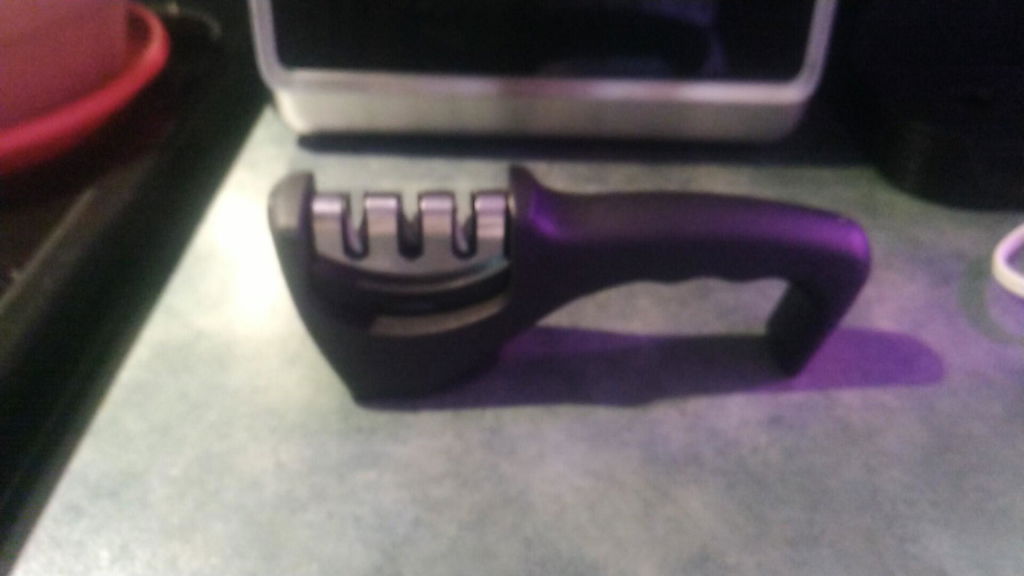
Properly sharpening your knife is the basic requirement for cutting onions without tears. A dull knife crushes the cells instead of slicing through them, and you cry twice as much. The simple rule: run the blade over a sharpener every two weeks if you cook daily. Hold the knife at a constant angle, about 20 degrees, and slide the blade along its entire length, from the heel to the tip. Count five to ten passes on each side. The reliable test: cut a ripe tomato. If the skin tears instead of splitting, your blade is not ready. A professional sharpener restores sharpness in a few minutes.
Tips for cutting your vegetables quickly (and without tears)
Cutting your vegetables quickly relies on three habits: an organized workspace, a stable cutting board, and a sharp knife. Here is what really works.
- Cut off the ends of the onion first, then cut it in half lengthwise. You get a flat surface, so no slipping.
- Leave the skin and root in place while cutting: they hold the layers together.
- Cut a grid pattern without going all the way to the root, then slice across. The onion separates into regular cubes.
- For other vegetables, cut a flat base first, then work in piles rather than one vegetable at a time.
- Use a mandoline for anything that requires regular slices. The time saved is clear compared to a knife.
This grid method is the one used by professional chefs. It takes thirty seconds to learn.
Common mistakes that make you cry longer
The number one mistake is leaning over the cutting board. The closer your face is to the onion, the more gas you breathe in. Stand up straight and work at arm's length. The second mistake is cutting slowly with a dull knife: each pass crushes more cells and releases more compounds. The third is keeping the ends and skin at the bottom of the table trash can during the entire preparation: they continue to emit. Throw them away as you go. A fourth mistake, less known: rubbing your eyes with your hands. Your fingers carry traces of sulfur compounds, and you prolong the eye irritation for several minutes.
Which technique to choose according to your cooking?
The right choice depends on your equipment and the volume to prepare. Here is how to decide.
- You cook occasionally on the weekend: put the onion in the refrigerator for 30 minutes and use your best-sharpened knife. No purchase necessary.
- You prepare large quantities: a closed manual chopper is the fastest. It eliminates the problem at the source, because the bowl contains the gas.
- You want regular slices: a mandoline with a safety pusher slices cleanly, evenly, and keeps your fingers protected.
- You are looking for the most durable solution: invest in a Japanese knife with a hammered blade and a sharpener. It is the option that improves all your cuts, not just onions.
The deciding factor remains the sharpness of the cut. A sharp blade, a cold onion, and airflow: these three elements together eliminate almost all tears. If you only have to remember one thing, remember that.
Tears in front of an onion are not a kitchen inevitability, but the direct consequence of unsuitable equipment. A dull knife, a room without ventilation, and sloppy cuts form the trio that makes you cry. Hell-kitchen-equipment selects utensils designed to correct exactly these points: the Ultra-Sharp Japanese Knife for clean cuts, the QuickChop Mini Chopper for chopping away from the gas, and the Fast Precision Mandoline for regular slices in complete safety. Each tool simplifies a specific step of your preparation. Add the one that matches your way of cooking and enjoy dry eyes starting with the next meal.
Frequently Asked Questions
Why do we cry when we cut onions?
When the blade breaks the onion cells, enzymes transform the sulfur compounds into syn-propanethial-S-oxide. This gas diffuses in the air and reaches the cornea. The tear glands react by producing tears to flush out the eye irritation. The more brutal the cut, the more cells are burst and the more gas is released. This is why a dull blade that crushes the onion makes you cry more than a sharp knife.
Does a well-sharpened knife really help not to cry?
Yes, and it is one of the most reliable techniques. A sharp knife opens the cells cleanly instead of crushing them, which releases less syn-propanethial-S-oxide into the air. A dull blade crushes the flesh and multiplies the surface area exposed to enzymes. Result: more gas, more tears. Regularly maintaining its sharpness, with a sharpener or a stone, remains the first thing to correct before looking for other tips.
Should you put onions in the refrigerator before cutting them?
Placing the onion 30 minutes in the refrigerator, or 10 minutes in the freezer, slows down the activity of the enzymes that produce the irritating gas. The reaction becomes slower, so fewer volatile compounds escape during slicing. This technique works well for one or two onions, but it loses its effect if you prepare a large quantity: the cold quickly balances out to room temperature. Take out the onion just before cutting it.
What is the most effective technique to not cry when cutting an onion?
Combining three actions gives the best results: a perfectly sharpened knife, the onion chilled for 30 minutes, and airflow that moves the gas away (extractor hood or fan pointed at the cutting board). If you need to finely chop, a closed manual chopper almost completely eliminates the problem, because the sulfur compounds remain confined in the bowl. For daily use, this combination is more reliable than a single tip.
Is cold water effective to avoid tears when cooking?
Rinsing the peeled onion under cold water, or wetting the knife blade, limits the diffusion of the irritating gas into the air. Water captures part of the water-soluble compounds before they evaporate. The effect is real but temporary: you have to repeat the operation if the cut is long. This tip works better on mild onions than on red onions or shallots, which release more sulfur compounds.